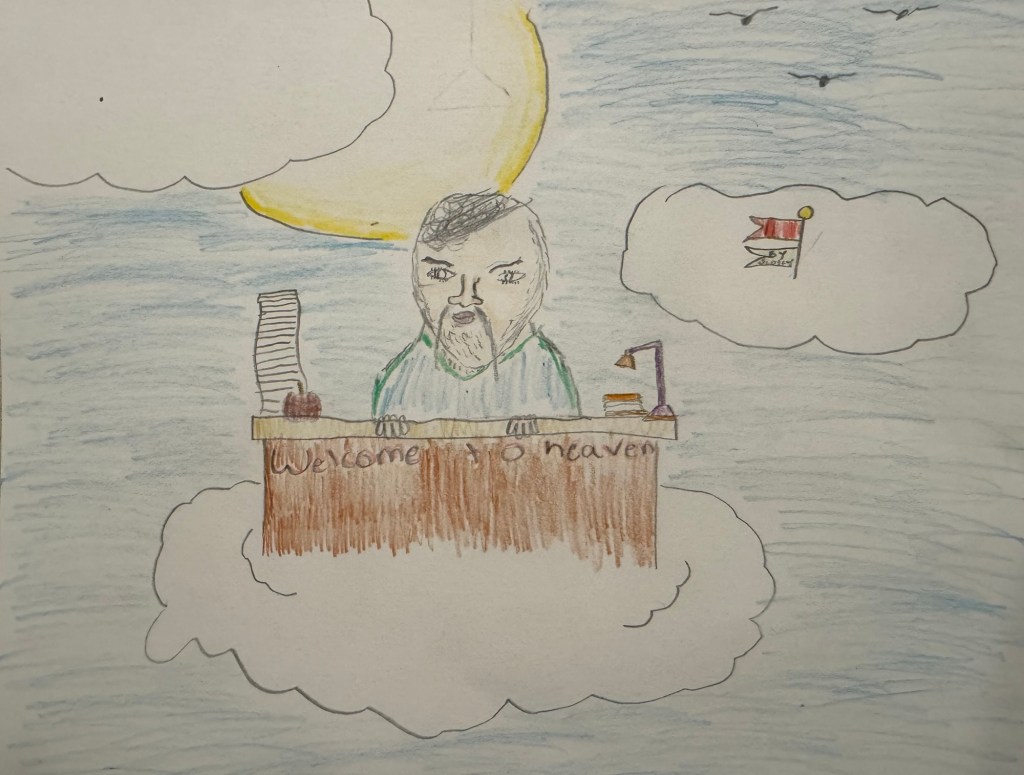
On an after-dinner walk during the boys’ first week of summer break, I was suddenly stricken by the realization that Danyelle and I are nearly exactly halfway done raising children, at least in the sense of housing them while they’re still legal minors. Cartter is a couple months away from his tenth birthday, and Scotty is just under ten years away from graduating high school. We’ve officially reached the high noon of parenting.
I had a similar realization a few days prior regarding Cartter’s developmental stage – the widening shoulders, the growing penchant for sarcasm, the little snort of self-conscious laughter – My God, I thought, the child is a tween! Not having ever really considered the term before, I used Google AI to check my intuition, only to find that yes, Cartter fits the bill nearly perfectly. He places increasing importance on fitting in with his peers; he’s interested in trying out new sports; and, according to the internet, he needs more than ever Danyelle’s and my emotional support and guidance, birthrights which at this parental midterm, I would say I deliver consistently, if somewhat clumsily.
Fitting in with peers and trying out new sports have gone hand in hand: Cartter’s deepening friendship with the Rivers boys next door has revolved largely around competing in various backyard games. He’s driven to prove his worthiness in these contests. The transformation of the park behind the house into a makeshift children’s golf course has been both a great pastime and an impetus for pursuing lessons at the driving range. The baseball games that break out on a near daily basis have prompted Cartter and Scotty to take batting practice with each other in the front yard while they wait on their friends to come challenge them. I’ve done my part to fan the flames of their interest: I took them out to the golf course a couple months ago, and it was deeply satisfying to boom drives in front of them, but it’s in batting where I’ve been the most use in scaling their abilities and better equipping them to compete with their buddies.
It’s a wonderful feeling to see my child looking out at me, bat in hand, eager for me to pitch to him. I’m a sucker for it. The great sportswriter Roger Kahn nurtured his son’s interest in baseball by hitting sharp grounders to him, commanding him to keep his head down and covering his arms in bruises. I helped my two boys fill a five-gallon bucket with tennis balls, which I lob to them underhand so they can wallop them with a metal bat. Sometimes I wonder if maybe my style is a little too soft, if perhaps it fails to instill a sense of humility.
Recently, on a day when I moved our batting practice from the front yard to the park out back, I found myself the subject of Cartter’s ridicule. A proper game broke out when the neighbor boys came calling. The insult came when, having assumed full-time pitching duty, I missed a chance at a pop fly that sliced foul past the first-base line. Trotting gingerly after it across the pitted, gumball strewn terrain, I finally jogged down and back up the other side of a shallow drainage ditch before the ball dropped just out of reach. “Oh, come on!” Cartter cried from the outfield. “Why didn’t you catch it? It went right between your arms!”
“I was trying not to break my ankle,” I said, having managed, I later discovered, just a minor strain of the ligaments below the bony prominence of my left fibula. Subsequently, the batter hit a long fly ball that bounced off Cartter’s hands like they were made of frying pans. I said nothing.
When it comes to childish games, I have no trouble suppressing my natural competitiveness in the boys’ presence, and I’m happy to give them plenty of leash as they learn how to navigate their social dealings with friends, even if I’m to be derided and underappreciated while doing so. One might characterize my parenting in this regard as gentle and restrained; however, it’s not all soft lobs and tennis balls for my little tween, for I have a devilish tendency toward teasing that sometimes comes across more sharply than I realize. Little provocations, intended as slow rollers to be easily picked up and thrown to first, occasionally end up more like the batted balls of Roger Kahn’s father, sizzling off the infield dirt and taking tricky hops that leave bruises.
In the same way that I can’t resist incessantly calling Cartter and Scotty “my babies,” and like I for days relished referring to Cartter as “my little tween,” when Danyelle mentioned Cartter wearing his hair too long, I was compelled to make a joke of it. “Come watch this,” I said to her, getting up from my spot in the living room. I grabbed the beard trimmer from my bathroom and flipped it on so it would buzz menacingly as I strode into Cartter’s room. “I have to cut this,” I said leaning in over Cartter, who sat on his little swivel chair reading one of his Diary of a Wimpy Kid books for the umpteenth time.
“What?” he said with panic, and then to my great surprise he stiffened, lifting his shoulders up toward his ears, as he squeezed his eyes shut and said weakly, “Don’t buzz me too close!”
My boy actually thought I was serious, that I was going to shear his head with my beard trimmer. I felt horrible. I turned off the clippers and hugged him, and he cried a single tear. “Was it a mean joke?” I asked.
“Uh huh . . .” But before he admitted his hurt feelings, he hid his face in my shirt and tried to deny them. “It’s okay,” he said breathing shallowly to stifle a sob, feigning casualness while suffering newly intensifying emotions, torn by conflicting notions of his father’s power and the same man’s fallibility, desiring at once to be his own self and for me to approve. Yes, at this parental halfway point, Cartter’s taught me what it means to be a tween.
Braves
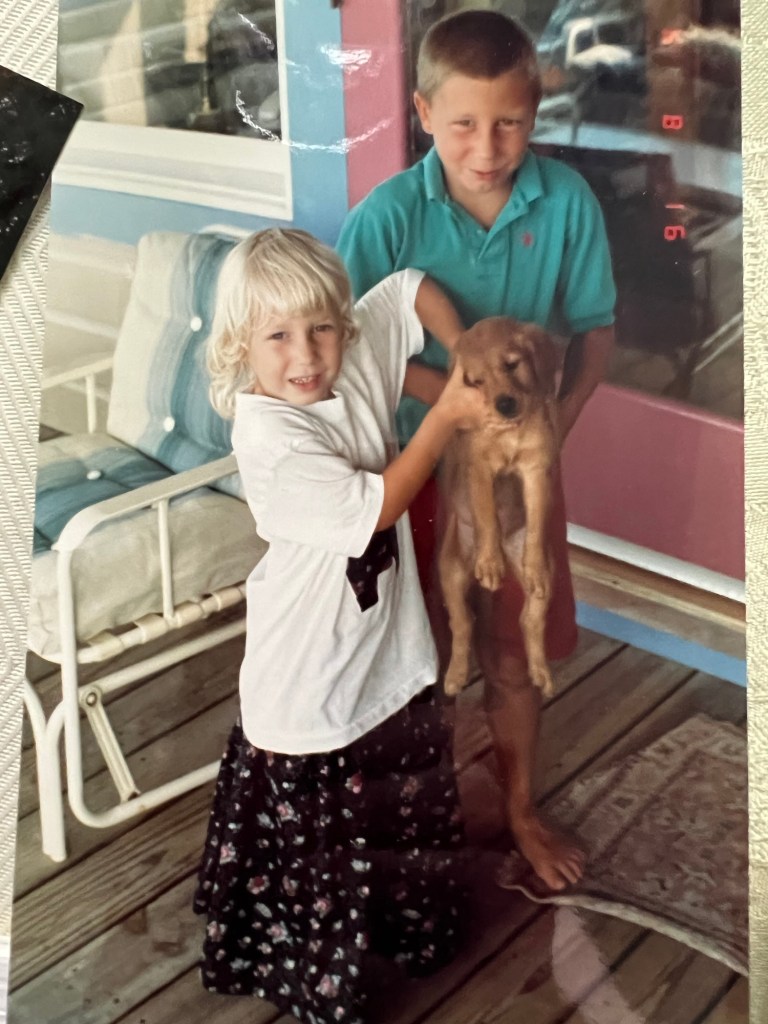
Baseball was one of the lasting bonds I forged with my father during my tween years, and I don’t mean the brand I played in Little League. I came up through tee ball, coach pitch, machine pitch, and kid pitch and made the all-star team at the Isle of Palms rec department my nine, ten, and eleven-year-old years. Dad watched the games; he pulled for my teams; and he offered small encouragements that put me in my place as much as they boosted my self-esteem, but I don’t remember him ever playing catch or hitting fly balls to me. He played in a men’s softball league and was more interested in his own game than mine. Where our baseball lives truly intertwined was in the living room on Sullivan’s Island, watching the Braves on TV.
My tweendom began right around the time the Braves signed reigning Cy Young Award winner Greg Maddux and traded for slugging first baseman Fred “Crime Dog” McGriff enroute to a 104-win season that saw them run down Barry Bonds’ Giants in dramatic fashion to win their third consecutive division title. That season came on the heels of back-to-back World Series appearances, and the historic success it predicated cinched my Braves fandom for life. With three hall-of-famers anchoring the pitching staff into the next decade, Atlanta went on to win eleven more division titles in a row, winning the 1995 World Series along the way. I was eleven and in sixth grade that year.
In the 90’s they were on TV every night on TBS. “You can always count on them,” Dad said. Back then I loved the Jordan Bulls and the Peyton Manning Tennessee Vols, but watching those teams around my father was insufferable, so jaded and abundant was his criticism. He saved all his patience, admiration, and earnest rooting for the Braves. I remember punctuating summer evenings spent bicycling to Dunleavy’s Pub for hot dogs peacefully sitting with Dad as darkness set in outside and the Braves dominated the rest of the National League on TV. As I matured, the two of us leaned into our shared respect for the team so much that at one point during his divorce, Dad said to me, “We have to be able to talk about more than the Braves.” At the time, I hated him for it. I was sixteen.
I followed the Braves almost religiously through my twenties and thirties, watching more games than I missed and talking to Dad about the team for long stretches on the phone with regularity. Watching my young sons growing up, I forgot there was a time before I was a Braves fan. I saw them failing to show any real interest in baseball, and I thought they would never catch on. In the wake of a Braves World Series victory in 2021, their first since ’95, I almost lost hope of passing down my love of baseball. Streaming services and fractured broadcast rights diluted the dependability Dad had so appreciated in the TBS era; the team hit a couple of down years; and the summer I turned forty, I stopped watching. Then this summer, the Bravos opened the season at a torrid pace, and I bought the subscription package that guarantees all the games. Now at eight and almost ten years old, Scotty and Cartter are hooked.
The Braves are an excellent remedy to summer’s creeping boredom, and Cartter in particular has fallen into the rhythm of the schedule – night games during the week, occasional late afternoons on Saturday, early afternoons on Sunday – you can always count on them. This past Sunday he announced from the kitchen at lunchtime, “One hour and thirty-five minutes until the Braves are on.” Understandably, he’s disgusted by rain outs.
Analytical and numbers-bent as he is, the game’s statistics exert a natural pull on Cartter. The more he watches, the more he wants to know about all the different figures – What are K’s? What is BB? What is ERA? – and he grasps their meaning quickly. When I explained that ERA is earned run average, or average runs surrendered per nine innings, he was immediately able to calculate the ERA of a pitcher who gives up ten runs in ninety innings, twenty in 180, and forty in 180. This pleased him, as it put him in the category of the knowledgeable, the baseball savvy, right alongside his father – until I dashed his self-esteem just as quickly as I’d built it up.
I had no idea that Cartter was unfamiliar with percentages. When I told him batting average was a percentage, I was genuinely surprised he didn’t know what I meant. “You don’t know percentages?” I said, “It’s so easy.” These words crushed him. I was lying on the couch, and Cartter was sitting in the rocker with his pot pie lunch watching the Sunday afternoon game. Fears of inadequacy no doubt rising within him, he was unable to quell a quick burst of tears.
Lucky for both of us Cartter’s a fast learner, and he proved me right: Percentages are easy. Within minutes of my clumsy mistake and his overreaction, he was able to differentiate between at bats and plate appearances, batting average and on base percentage, and to calculate on base plus slugging – What’s your OPS if you go one for four with a homer and a walk? What if you go three for four with three singles? Now he’s truly one of the initiated.
Independence
The boys got top marks on their report cards, and Cartter scored extremely well on the standardized test that was administered at the end of the year, but the highlight of the feedback that came home at semester’s end was the comments from Cartter’s homeroom teacher on his social studies work: “Cartter has shown exceptional dedication and understanding in Social Studies this last quarter. He effectively analyzed the causes of the American Revolution, delved into the significance of the Declaration of Independence, and grasped the complexities of the formation of the United States’ first government. Cartter created a podcast highlighting the impact and perspective of Ben Franklin, wrote a letter declaring his independence from ‘playing with his friend Max,’ and researched the battles of the American Revolution.”
Cartter was sitting on the rug between the kitchen and the living room after dinner when I mentioned to him that I was thinking of declaring my independence from playing with Max. His jaw hit the floor. Then, when he started trying to explain, his brother’s eyes liked to have jumped out of his skull: “You wrote that!” Scotty said, “And you turned it in!”
In the interest of relating how big a piece of shit Max is, here are some tidbits from a stream of consciousness text that his mother sent to Danyelle the night before she and her family left for New York for the summer (For context, Jeannette is Puerto Rican, and her husband, Max’s father, is Indian): “I know sometimes they hear stuff at home so not sure if you’ve talked to the boys abt race . . . I just told Max to ignore everyone today and he said he was playing with Dash ignoring everyone and your boys and the Rivers and Mac all the sudden started making fun of Max and his intelligence and race? . . . I don’t get involved with this stuff because I know Max can push buttons but when race is involved I’m definitely speaking up . . . so maybe take this opportunity to talk abt that.”
Early tween though my eldest may be, he and his brother are still too ignorant to be racists. Danyelle had to fight the urge to respond with a fiery text of her own, and in the end, I called Jeannette’s husband to let him know what his wife had said and to assure him in no uncertain terms that “that didn’t happen.” Ironic that while tweendom is supposed to be a time of increasing independence from one’s parents, Cartter is seeking independence from tedious friendships. Knowing that navigating peer groups and selecting friends is a centrally important facet of early adolescence, when I found out about Cartter’s declaration, I cheered.
Morning Practice
Cartter and Scotty are swimming long course (albeit mostly in a short course pool) with my group out in Park Circle, marking the first time they’ve spent a summer swimming for someone besides the neighborhood Creekside Crocs. Each morning, we leave the house before eight and drive twenty minutes out to North Charleston, where Cartter logs up to 3,500 yards a day and Scotty approaches 2,000. The results have been gratifying.
For one thing, both boys are racking up victories at their summer league meets – Cartter is undefeated with one regular season meet to go and looks primed to sweep his individual events at the league championship meet, and Scotty remains without a loss in backstroke. Even better, the time we’ve been spending each morning has brought us closer together.
Part of morning practice’s delight is derived from the absence of unserious swimmers. At the Park Circle location, Cartter and Scotty and I are members of a select group. We have dryland sessions; we experiment with new drills; we push limits. We accomplish more than we would if the part-timers who only care about summer league were there clogging up the lanes. In the minivan, on the way to and from the pool, the boys and I are part of an even more select group. We listen to Two Pros and a Cup of Joe on the way out and The Dan Patrick Show on the way back. I’ve noticed Scotty is a lot more generous toward me with his smile lately, and I don’t think it’s a coincidence. The other day he came to me in the den and said, “Daddy, I have to tell you something . . . I don’t know why I’m saying this right now . . . but I love you.” The effect of morning swim practice on the rest of the day really is wonderful.
Rick (and Linda)
For a while, Danyelle has joked that she wants to name our next dog after the awkward owner of a miniature poodle, a man whose dog Sammy loves so much that she is driven to lick its genitals and hump the air in its vicinity. The owner Rick is well into his sixties and is quite the gossip: he seems to know everyone who has ever lived in all of the neighborhood homes; he avails himself of vacant remodels to better understand his surroundings; and he takes advantage of Sammy’s love of his little poodle to corner Danyelle and me on the street.
Rick isn’t unpleasant. Both Danyelle and I like him and his little dog. He’s just one of those people whose conversational appetite outweighs his aptitude. For the amount of time I’ve spent with Rick, I shouldn’t have heard any of his stories more than once, but the fact that retreading the steps to his home’s second story yielded the discovery of a discarded bag of Burger King fascinates him to the point of repeating himself. Plus, he can’t help but pay a little extra attention to the female form, which, along with his habit of wandering through neighbors’ construction sites, makes him something of a creep in the eyes of those who’ve failed to acquire a taste for him.
After over thirty years in Creekside, Rick and his wife Linda are just a few weeks away from moving to California to be closer to their daughter and grandchildren. The pending move has only increased Rick’s inclination to stop and talk when we pass each other on dog walks. Just the other day, when Danyelle and I caught him in front of his house, he was driven to ask us in so that I could see the baby grand piano he and Linda are selling. “It’s emotional,” Linda said of letting go of so many of their possessions. Their things have become storehouses for a lot of memories, and the piano, which their daughter grew up playing in the front room of their home, is a very large storehouse.
I played a few songs for Rick and his wife, and the impromptu invitation turned into another invitation, this one planned in advance for after dinner a few days later. It included the kids, who brought over Cartter’s acoustic guitar and performed some of the tunes they’ve learned together at School of Rock, which the adults graciously endured. After the little concert, we sat in the kitchen and admired the view of the park while the kids ate ice cream. Rick told his story about the bag of Burger King in his steps again, but we also got to know these people who have been our neighbors for the last ten years. Turns out Danyelle went to high school with Rick and Linda’s daughter, and I took piano lessons from the same daughter’s music teacher Donald Mixon. No doubt Rick and Linda sat through recitals in which I performed as a child.
Transition has a way of opening people up and of slowing down time. Maybe if we all remembered our stay here on Earth is temporary, we’d get to know each other a lot more quickly and easily. Either way, Danyelle is happy that since Rick will be gone, the path to giving our next dog his name seems clear.
 The Raging Elitist