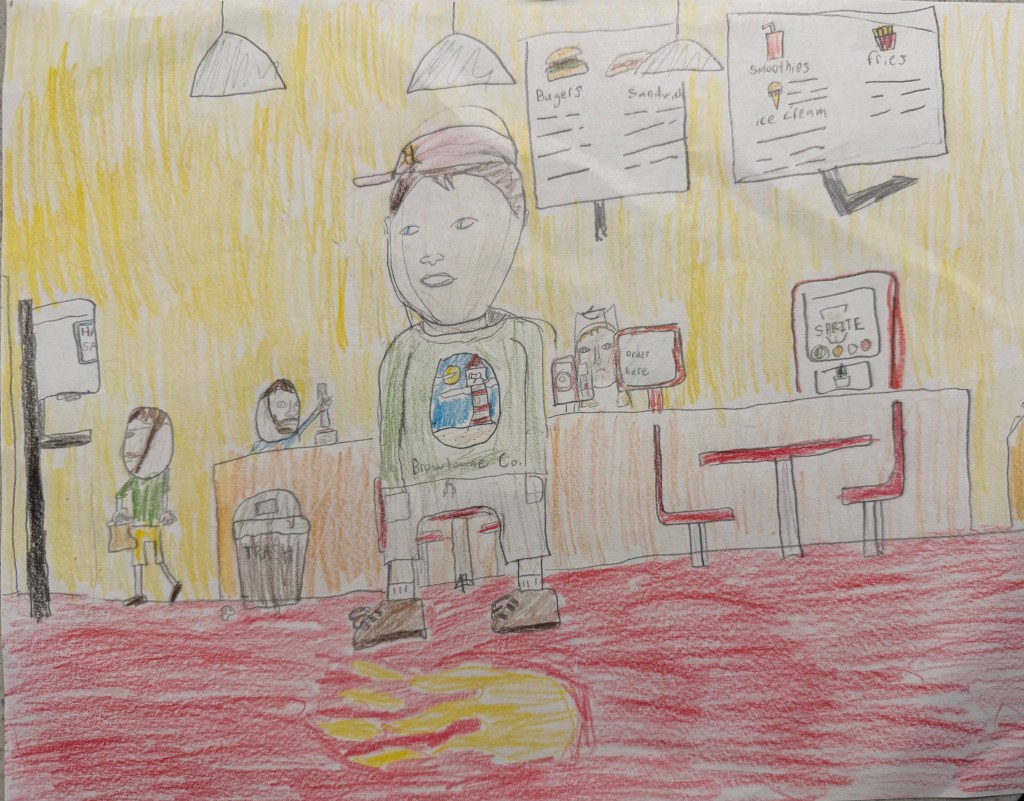
Watching my nine-year-old swim his first ever 500 free, I stood on the deck and shook my head in disgust while writing down 50 splits of forty-two and forty-three seconds. Cartter was babying his race, swimming his way to a time that didn’t reflect his preparation or his ability. A week prior I’d watched him split forty-ones enroute to a 6:52 while dodging teammates coming off the wall in practice, but that time wasn’t official. It wasn’t measured by an electronic timing system or swum under the watchful eye of registered officials; it didn’t get logged into USA Swimming’s database, and it wouldn’t appear next to his name in the heat sheet for the swim world to see. In short, it didn’t count. This poorly swum race would, though. At the end of it, the meet results would list Cartter as a 7:00 500 freestyler. That time, as a matter of indisputable fact, would be his best.
The finality of the clock is one of swimming’s many cruelties. For athletes more experienced than Cartter, years of sacrifice and millions of yards swum can be seemingly swept under the rug, replaced by a single, defining number. Harsh though it may be to judge a person this way, best times communicate a lot – not just about prowess, but about training history and commitment – they reveal whether someone is truly a member of the initiated. When I meet someone who says they were a swimmer, the first thing I ask them is what their event was. If they weren’t just a summer leaguer and can actually name a stroke and distance, I’ll ask “What’d you go?” The answer frequently comes with a far-away look and a slight tone of reluctance. Most of us who really swam know we could have gone faster; we don’t believe the time really tells the whole story.
I remember nearly all my best times. The most exhilarating swim of my life, my fifteen-year-old long course 200 breaststroke, I remember down to the hundredth: 2:30.54. I went 4:10 in the short course 400 IM, 2:10 in the short course 200 breast; I’m embarrassed to admit that the best 500 of my life was a 4:56, swum on the front half of a 1000 when I was sixteen years old. In a career cut short by family trouble and unrealized goals, I never really figured the race out. To this day, I still feel like the time is misleading. I could hold 1:02s for 3,000 yards straight; I trained with swimmers who went in the 4:20s and 4:30s; I know I had a much better swim in me; but to anyone who asks, 4:56 is the definitive answer, the one by which I’m judged.
In much the same way times serve as an efficient means of communication for more seasoned swimmers, the positive feedback they provide and the rank they confer quickly hook young people, like Cartter, into the sport. Once you start paying attention, times (on the surface) are easy to understand. Cartter asked me recently who invented state times. Also, who invented the state meet? The separation between state swimmers and non-state swimmers is an early distinction, but a finer understanding of times and their significance quickly follows. The weekend before Cartter’s 500, one of his teammates was at an out-of-town meet where he won the 50 breaststroke with a ‘AAAA’ time. I showed Cartter the results on my phone, and I watched as his eyes looked first to the time, then to the event, and then, widening, back to the time. “What?!” he said, “Thirty-five?! That’s faster than my backstroke!”
Cartter’s fascination with times is not unlike his recent interest in football cards, in that his ability to remember and recite the statistics is ahead of his broader understanding of the sport. The other night he asked me at bedtime which end swimmers would start from in 50-meter races once we flipped our home pool to long course. I told him it would be from the far end, and he said, “Oh yeah, there are blocks down there.” Then he said, “Do you have to jump over the white thing?” He was talking about the bulkhead, and I had to explain to him that no, the blocks would get put into the bulkhead; he wouldn’t have to jump over it and risk injuring himself. Then he asked if short course was done “forever,” afraid that the only place he’d ever be able to swim the 100 I.M. again would be summer league. He doesn’t know if six touchdowns in a season is a lot, and he doesn’t appreciate the superhuman effort required for elite swimmers to split twenty-five-second 50s in the middle of the 500, but he knows all his best times, and he’s well aware of a multitude of different time standards for his age group.
Once kids start attaching meaning to tenths of a second like Cartter has, they often become highly motivated to train, even if it means making sacrifices. When I mentioned to Cartter that his school was putting together a 10U tackle football team, he was immediately interested. Then I told him the practice schedule, and he realized he’d have to miss swim. His eyes welled for a moment, and even though I told him it was okay, there was no convincing him. However in vogue it might be to trumpet the benefits of playing multiple sports, the fact is that swimming is different. With very few exceptions, kids who swim in college start year-round at a young age. To miss practice is to fall behind, and thanks in large part to his interest in improving his times, Cartter already knows it, even at just nine years old.
Sometimes I wonder if my kids wouldn’t be better off spending more time playing rec league ball sports instead of dedicating themselves to the endless series of tests and the inevitable comparison to others inherent to swimming. Despite the initial pain he felt at foregoing a tackle football career, Cartter doesn’t seem to have any such misgivings. “I like the whole times thing,” he says, citing the pure simplicity of it: “There are four strokes, and you’re like, okay, now I get to swim this event,” whereas in other sports there are people trying to block you and quick decisions to be made in the moment. He certainly has a swimmer’s mindset, and at the rate he’s improving, it won’t be long before he understands a lot more about the effort required to keep dropping time and to compete at higher levels.
Watching Cartter come to life in the final hundred of the 500, as young kids so often do, I had to remind myself that it was only his first time competing in the event. As a coach, I want my swimmers’ times to reflect their training and ability, but for most kids, there’s a learning curve, especially when it comes to longer-distance races. Criticizing a kid’s effort too sharply in the early goings would be a mistake. Even the most experienced swimmers struggle to give the utmost in a race like the 500.
One thing I’ve found in adulthood is that when I encounter old teammates, times don’t come up in conversation. Instead, there’s a mutual acknowledgement of what the other person endured, and a certain amount of grace allowed for what an athlete might have accomplished but never did. I try to offer my swimmers a similar kind of deference when they’re learning middle- and long-distance races. When Cartter came up to me after the 500, I asked him the same question I ask all the first-timers: “Do you think you could’ve gone faster?” The answer’s always the same: maybe a kid’s out of breath; usually there’s a relieved smile; sometimes, there’s even a little laugh. “Yeah,” they always confess. Welcome to the club, kid.
More Best Times
As a coach, I gauge my young swimmers’ meets with my eyes and judge their times against what I see in practice as much as I judge them against their previous bests. Sometimes, looking at things this way causes me to miss the progress being made. Counting his 500 swim, Cartter ended up going ten best times in ten swims over the weekend, and he won three events – the 50 fly and the 50 and 100 back. He had never previously won an event at a year-round meet.
Meanwhile, Scotty improved in all his swims, and by a lot. He swam the 50 free for the first time in competition. Coach Jessica, who works with him at practice, guessed he’d go 46. I guessed 50. His goggles filled on the start, and he took a few awkward strokes with his face up while stalled out underneath the flags before grinding to a 48. For a seven-year-old, he is one tough son-of-a-bitch.
Not until writing this piece did I realize how well he actually did. Danyelle took a video of him swimming the 25 fly. At the end of it the camera pans over to the scoreboard where his time is listed as 28 seconds. I remember standing on deck, watching Scotty swim and thinking his stroke was improved, only to second-guess myself when I saw the time on the board. When I checked the results before this writing, though, his time was listed as 24 seconds, five seconds faster than his entry. I thought there might have been some mistake and actually timed the swim that Danyelle recorded. I got 23.6. Look out summer leaguers.
Favorite Subject (continued)
Scotty’s project on Teddy Roosevelt produced a humorous video in which one of his Teddy portraits subtly moves its mouth while Scotty narrates. “My name is Teddy Roosevelt,” he says. “Scotty Lupton read a biography about me.” Scotty speaks in a hushed, rapid way, his sentences tailing off at the end and spilling quickly into the next. It lends a very serious nature to the silly animation, as if Mr. Roosevelt is in a hurry to deliver this information and get on to more important things. I’ve enjoyed reciting Scotty’s lines back to him, especially the one in which he says he studied politics or “pull-IT-ics” as he pronounces it. Scotty has taken to correcting me: “It’s POL-itics,” he says.
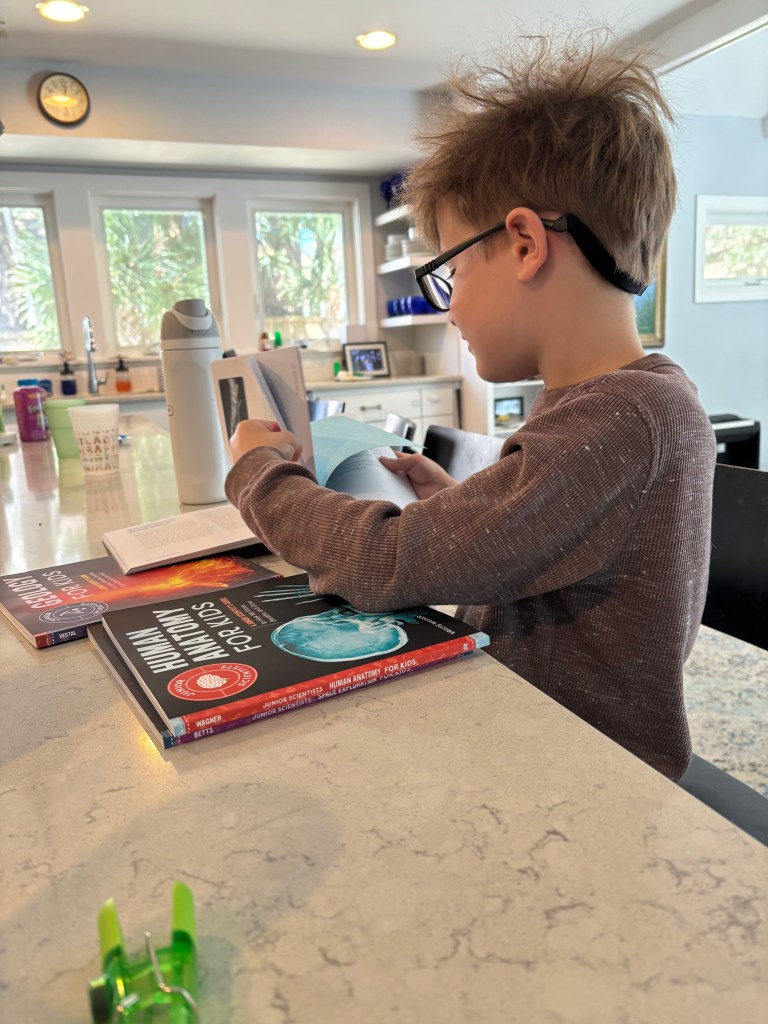
His Roosevelt project done, the reading teacher assigned him and his classmates with the task of picking out another nonfiction book, only this one could not be a biography or any sort of narrative. She wanted something with text-book-like features – glossaries and information boxes. Aunt Betsey helpfully provided an anatomy for kids book. Scotty said he couldn’t wait to get to the last chapter, the one on the reproductive systems, because there were pictures of the insides of a penis and a vagina. I was a little worried what he might glean, but it seemed to amount to about nothing. “I wish it talked more about poop,” he said in the end.
Both Scotty and Cartter have recently been devouring a comic series called “Bunny vs. Monkey.” They can sit for hours with their nose in a BVM book giggling to themselves. Between the two of them, I’m surprised that Scotty seems to be the more willing reader. I always thought Cartter was going to be the literary one, but he seems to be gravitating more toward math and science. Scotty, on the other hand, loves to read. He loves all sorts of books, and he loves to write too. His teacher says he comes into the classroom early and asks for extra time to journal. Here are two poems he randomly penned at the house one weekend, both untitled:
Untitled #1
It’s spring
flowers start to bloom
a bear comes out from hibernation.
Then, Summer comes.
Sand spins and swirls.
The beach days fly past;
Fall is here.
a squirrel scurys up a tree.
It cools down
winter is coming.
Soon the land is covered in a thick white blanket
for months.
Birds start to chirp,
the sun rises;
it’s time to start . . .
A NEW YEAR.
Untitled #2
Here’s Simon.
He runs out the door.
He flies through the popys,
and into the field.
He passes the blooming flowers,
and feels the wind on his fingertips.
Simon knows he belongs,
he knows it from his head,
to his toes.
In fact
Simon knows . . .
that everything belongs.
Rude Boy
Recently, I had a talk with the boys about appreciating their mother. Scotty in particular has started showing signs of an entitled attitude toward her. Hungry after getting home from swim practice, he fussed at her while she prepared his and Cartter’s dinner: “You didn’t do this when we were at school?” he said with a tone of irritated disbelief.
Scotty’s lack of a filter does have its upsides. Whereas Cartter has entered into the phase where lots of things are “weird” and not of interest, Scotty’s taste is uninfluenced by other’s expectations or the need to fit in. He selected a Vince Guaraldi waltz for his class’s impromptu end-of-the-day dance party, and it was unsurprisingly met with a lukewarm reception. Scotty was unbothered. He continues to request Vince Guaraldi in the car with his mother and to play his favorite songs on a loop with the CD player in his room.
I’ve listened to Vince Guaraldi for almost twenty years now. Safe to say he is one of my favorite artists and possibly the biggest influence on my own playing. I know more of his songs on the piano than I do of any other composer. Lately, though, because of Scotty, my appetite for his music has increased. Two of Scotty’s favorites are “Schroeder” and “Heartburn Waltz,” the former of which I always ignored, the latter of which I was ignorant. Because of Scotty playing them over and over, I’ve realized what gems they are, and I’ve started learning to play them. Suddenly, I have newfound drive to learn all the songs in my chunky Guaraldi song book.
I was sure Scotty would be impressed, flattered, tickled that I was going to the trouble when he heard me playing. I remembered Cartter’s sparkling delight when I played the theme from “Toy Story” for him when he was a toddler who still dressed up like Woody. Cartter’s always been sentimental that way. He’s a sweet boy, quick to smile, and just as quick to blush. Scotty has a little more edge to him. When I played Heartburn Waltz for him, a tricky little tune that I don’t have anywhere close to tempo yet, I had to tell him to wait a second so he wouldn’t run out of the room. Upon listening for a few seconds, he squinted at me and said, “That doesn’t sound like it.”
Tattle Tale
Sweet though Cartter may be in comparison to his brother, he doesn’t quite understand that some conversations aren’t meant to be shared. He’s developed a sometimes-annoying habit of eavesdropping, and if it’s just his mother and me he’s listening to, he’ll interject with questions about whatever tidbit sounds the juiciest. Worse, he can’t be trusted to keep what he learns to himself unless he’s explicitly told.
Riding to pick up a bag of takeout from Pattaya Thai, Cartter let it slip to me how angry his mother had been that morning when she discovered I’d forgotten to put the cooly packs from the boys’ lunchboxes into the freezer. “She was like ‘What a jerk!’” he said.
I told him I couldn’t believe it, that calling his father a jerk in front of him was a total Trudy move, referring to Danyelle’s mother. Cartter asked what I meant, and I told him that Trudy tried to instill in all Danyelle’s siblings that their father was a bad man. Cartter understood, correctly, that Trudy did this, “just to make Grandpa mad.” He agreed that Trudy was a strange character and explained that one time Danyelle let Trudy take him and his brother for a walk so Danyelle could spend time with her sister visiting from out of town. According to Cartter, on that walk Trudy unsurprisingly told the boys that she was “friends with God,” and asked them wasn’t it nice that God was with them on their walk and that God was all around and that she could talk to God. I told him and Scotty that Trudy was a little dumb and a lot crazy and was irritated that Danyelle had left them alone with her. Then, we got back to the house, and Cartter told Danyelle all about our conversation.
Some Cartterisms
Riding down the Ravenel and into Mount Pleasant, the boys and I passed a billboard for a cosmetics shop, and Cartter asked me “Why do old ladies try to make theirselves young?” I said I didn’t know, and he said, “It’s creepy . . . The thing is, they’re not young.”
When I was doing the dishes one night, Cartter asked me, “Daddy, why don’t people get to vote for the president?” and I said that they did. Then, he said something about the electoral college, and I asked who was teaching him all this. He said that his teacher at school said that technically, the electoral college votes for the president, and I said that “technically” was the key word there. Later, at bedtime, he asked me, “Daddy, what’s the most confusing thing you ever learned?”
Driving home from practice, right before we took exit 29 and curved off of the interstate onto the six-lane highway that delivers us home each day, Cartter asked “When did people start building roads, and who invented roads? . . . And where do they know where to put them?”
Part of my speech to the boys about appreciating their mother more included the fact that Danyelle was the reason we had Sammy, and Danyelle was the one who took care of Sammy every day. Cartter responded that “Without Mommy, we’d have a sad life.” Then, catching himself, he added, “Without Mommy, we wouldn’t be a thing.”
Demon David and Celebrity Scotty
There is a seven-year-old on the swim team who normally swims at the aquatic center named David. Occasionally, he’s over at the sports complex where I work. He has orange hair and freckles and despite a good amount of talent, is a nightmare to handle at practice. Coach Doug once said point blank to him, “David! I have nightmares about having to coach you every day!”
I’ve learned that despite his relentless willfulness, David is actually a very friendly character. He ended up in a lane with Cartter for a moment one day, and he asked me, “Why is he so fast?” I asked who he was talking about, and he said, “Your son . . . why is he so fast?”
He’s really fond of Scotty, and he doesn’t know Cartter’s name. One day, he came up to me before practice started and asked where Scotty was. I told him Scotty wasn’t coming that day, and he followed up with, “Where’s Scotty’s brother?”
For whatever reason, Scotty seems to enjoy a kind of celebrity status among older schoolmates and swim teammates alike. When the boys play tag football before practice, Scotty gets picked well before he should, and if he makes a play, it’s celebrated more than it would be if someone else had made it. When I got home the day David wondered where he was, Scotty had taped a sign to the front of his shirt. It read “Fragile. Do not touch. (Hurt stomach)”
A Good Laugh
At the end of a Friday that saw Scotty stay home sick from school, Danyelle and I stood at the end of the driveway about to take a walk with our soon-to-be eight-year-old. His older brother was off playing football in the neighbors’ yard. Scotty kept on saying that he had a riddle, and at first I didn’t notice, but he basically launched into a whole standup comedy routine.
I barely listened while he rambled on about a plane having so many bricks and then having one less. He said the one fell out, and I questioned how we knew that, and he said, “It just did.” Then he went on about some man living near a bridge and a pond with a bunch of crocodiles, delivering all this information with hurried assuredness while I continued barely listening. When he asked how the man died, I said something about crocodiles, and he said, “No. The brick fell on his head.”
At this point I noticed that Scotty’s timing and delivery was impeccable. The pace of the setup, the tiny pause before the punchline, the accompanying expression of “Get it?” Everything was perfect. So I started listening. There was another joke about some large animals in a freezer, and then another about artists. “What’s Bob Ross plus Vincent Van Gough?” he asked. “Bob Ross minus what is Vincent Van Gough? . . . What minus Vincent Van Gough is Bob Ross?” From his tone Scotty let it be known that the missing “what” was very obvious. I didn’t get it, and he looked up at me and said with a slight nod and an upturn of his hand, “Pablo Picasso.” It was total nonsense, perfectly delivered, and the second telling gave Danyelle and me both a hearty laugh.










Resourcefulness
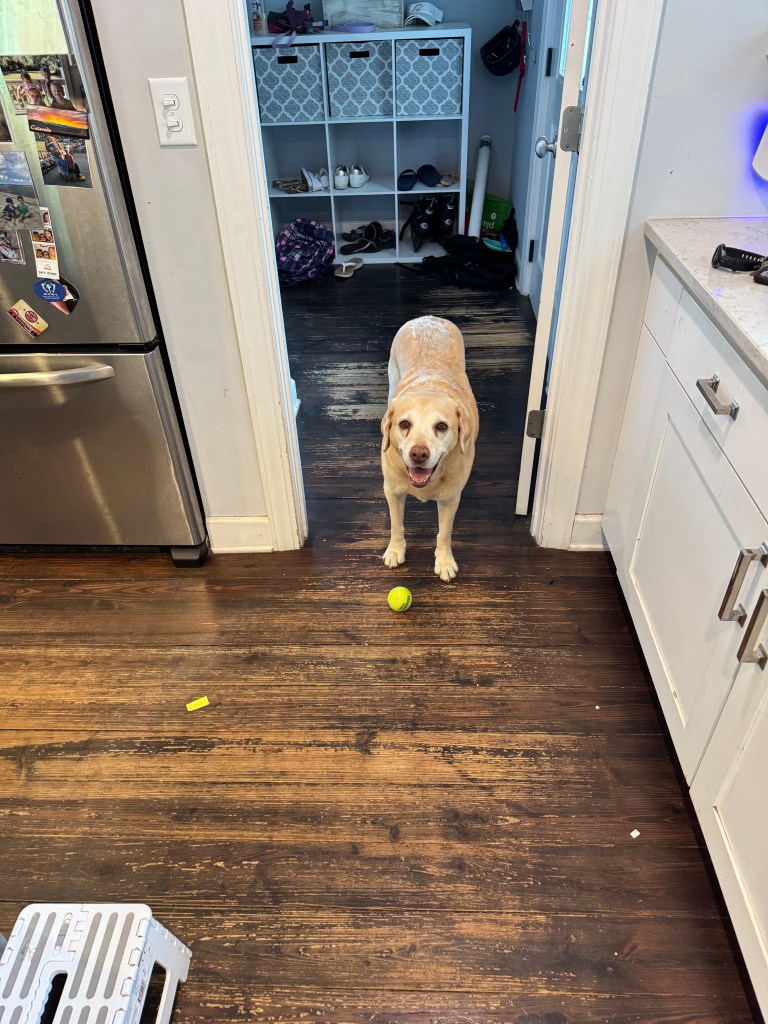
The boys are finally getting tall enough to help out with the dishes, and, however slowly, they’re improving at lending a hand with chores around the house. At the same time, they’re able to handle their business outside the house with increasing proficiency. When their football rolled down the storm drain for the umpteenth time, I tried for a few minutes to reel it in lying on my belly and reaching with a long stick; however, the ball had disappeared from view deep into the muck-filled tunnel that leads into the nearby marsh, and I soon gave up. A short while later, I heard an eruption of cheers outside and returned to the scene to find that Cartter had dived headfirst into the drain while the boy next door held his ankles. In this way he managed to retrieve the ball.
 The Raging Elitist