By 8:00 p.m. at the summer season’s first home meet, the stress is starting to wear on me. I’m running the timing system, which means I’m basically a one-man IT department responsible for verifying results and ensuring the meet runs on time. There are at least 300 people, probably closer to 400, crowded onto the pool deck, and many of them started the evening by checking their phones and remarking, “The app’s not working.” Ten minutes later some of them checked again and said to their neighbor, “Oh, it’s working now.” They don’t know I’m the one powering the hamster wheel behind their screens, that I’m the hub where technical problems and race results intertwine before kids’ times magically travel through the ether into their glowing handheld devices. The only person who has any idea what I’m dealing with is my friend Dave, who’s standing next to me working the starter job. Together at this meet’s outset, we avoided catastrophe, saved face with twenty-something other volunteers, and got everything off the ground on time. That was two hours ago, and I’ve been playing catch-up ever since. I try to look calm under pressure when I talk to the timers and awards volunteers. I make jokes and tell them I love them. They mostly laugh. In between these conversations, I bury my face in an ipad at the score table where I’m busy fixing all the mistakes that happened when we started without the timing system up and running. I’ve played it off well so far, but when a mom on the team comes by the table with corrections to her lane’s times scrawled on a heat sheet, I have to take a deep breath. “Sorry!” she says, and I immediately feel bad.
“No, you’re good,” I tell her, and she’s on her way back to her post.
I just looked up and saw Cartter standing at the edge of the pool with his goggles on, and some part of me is aware that my kid is about to dive in and swim, but the part of me that’s in command is busy trying to print ribbon labels. After Dave tells the next heat to take their marks and sounds the electronic horn, he taps me on the shoulder and points: “There he goes,” he says. When I look up, I see Cartter surge on the second half of the 25 butterfly, overpowering the field enroute to another team record, his fifth in five individual swims to start the season. The little boys standing next to me from the opposing team are cheering. Cartter told me they’ve been talking trash to him, and I told him to let his swimming do the talking. When he zooms past their best butterflier, their cheers are suddenly silenced, and they look on in stunned defeat.
“20.4,” I tell Dave when the time flashes across my screen. I’m pumped. I saw major adjustments in Cartter’s swim – feet closer together, arms in sync, proper timing – he took my input, put it to use, and reaped the benefits. I still see glaring flaws in his stroke, but there’s no doubt that his butterfly works, and if I coach him properly, it’s going to get a lot better. I love the irony that my kid would be a butterflier.
“You’ve got a swimmer,” Dave says a few heats later. “How does it feel?”
By this time, I’ve made it through the gauntlet of timing issues, and the two of us are momentarily sitting down as darkness sets in around the pool. I lean in close so as not to be overheard by the children and parents seated around our little enclave. “Honestly,” I say, “it’s kind of a mind-fuck.”
Cartter’s been putting our summer league on notice to start the season. In addition to his individual swims, he’s also led two relays to team records. I’ve coached kids like Cartter before, kids who look at me with total trust, talented kids who can make stroke changes on a dime and who will endure great suffering in practice, because they believe that if I ask them to do something, then it’s important. At nearly nine-years-old, Cartter is just about the same age as a young prodigy I once coached at MPSC named Daniel Kassis. The way Daniel used to look at me when he was receiving instructions frightened me. His dilated pupils made me aware of my immense power, and I worried about whether I would damage him. An incredible young workhorse, Daniel won his first state title in the 500 free, and a rival coach from Spartanburg told me it was the best nine-year-old 500 he’d ever seen. Daniel accelerated all the way through the race so that in the middle, his high body position and the ferocious kick that trailed it made it look like he was swimming with his ass on fire. After writing down a split time and finally realizing he wasn’t going to let up, I looked over to his father who was counting for him and shrugged in disbelief. When it was over, Daniel was so exhausted that he staggered like a drunk on his way to the warm-down pool. The only comparable race I’ve seen was the following day in the 200 free when Daniel again swam with his ass on fire but miscounted and stopped for a moment at the 150. The mistake cost him, and he ended up finishing second to a much bigger boy who was ten. After that swim, Daniel walked over to where I stood behind the coaches’ table, his eyes unblinking, his lungs visibly pumping beneath his ribcage, and tears involuntarily streaming down his face. At nine years old, this child was able to transcend the normal limits of human endurance in a way that few people ever will. He had developed not just an immense capacity, but an appetite for suffering, and I helped him do it.
Sitting at the timing table in the dark as little kids flail their way up and down the pool, Dave wants to know why my offspring’s budding talent isn’t pure elation for me. “It is,” I explain. “I’m so excited about it that I have to check myself. It’s hard to separate what he wants from what I want.”
For all of Cartter’s life, he’s seen me as a swim coach. We have a video of him as a two-year-old walking around the house with my car keys telling his mother that he’s going to his “wim meet.” When I visit his school, his classmates want to know who the fastest kid I ever coached was, because Cartter proudly tells them, “My dad’s a swim coach.” I was his first summer league coach. I taught him side breathing. I taught him how to dive. Now I’m his first year-round coach. I taught him how to swim butterfly and breaststroke. Of course, Cartter is drawn to the sport. When he sees me leaving for a year-round meet on the weekend, he wants to know when he can swim in one. In practice, he refuses to let up, pushing kids much older and more experienced. His habits, his budding physique with its widening shoulders and floppy ankles, his will to compete – it all screams swimmer. He follows me around the deck when I coach the novice group before his practice; he watches NCAAs with rapt attention and says he’s going to be a college swimmer; he watches a DVD of the 2008 Olympics and imitates Michael Phelps’ underwaters at his summer league meet. Yes, I’m elated. It’s like every day of my life is take-your-kid-to-work day. Every day I see Cartter in practice, he gets better, and every day we understand each other more and grow closer. It’s like magic, but just beneath the surface of my excitement, there’s fear, fear that Cartter’s interest is really just an eagerness to please me, and fear that I’m using that eagerness to serve my own ego.
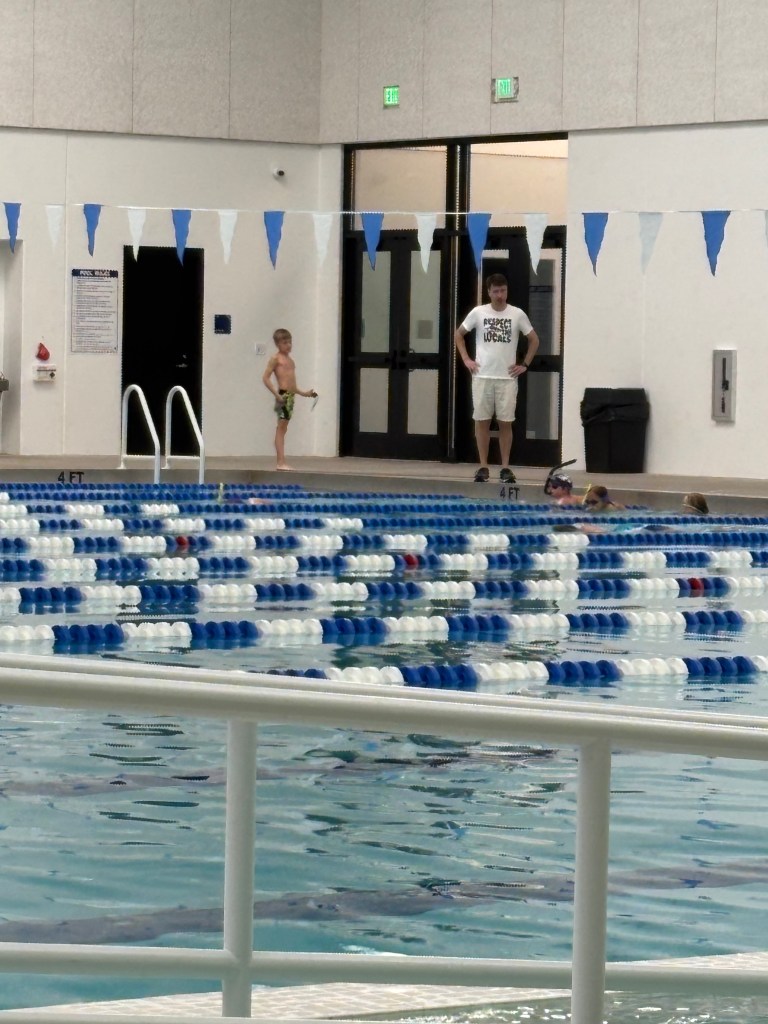
Simply put, Cartter’s success in the pool makes me look good. Parents on the summer team see him winning, and they want to know about the program in North Charleston. Dave wants me to give his kid lessons. When my wife records Cartter’s butterfly race, she captures the voice of a man standing behind her checking his heat sheet to see who the kid in lane three is: “Cartter Lupton,” he says. “Jesus! Cartter Lupton!” These people see what my son is doing, and they think, “John is a really good coach.” Watching Cartter apply the lessons he learns from me, I can’t help but think it myself sometimes. I imagine coaching him to a state championship the way I coached Daniel to several all those years ago. I think about how it would validate my sense of expertise and the memory of my own talent in the pool. I think about how people in the year-round swim community would view me if Cartter’s name were atop the results at championship level meets, the accolades that would follow, the boon to recruiting that it would represent. It’s an ego trip, and the thought that it might be driving my kid’s level of participation in a brutally difficult sport is troubling.
I worry that Cartter will grow to resent me. For one thing, I ask a lot of my athletes in practice. Such is the nature of the sport. Another MPSC prodigy once summed it up thusly on the ride home from practice with her mother: “Mom,” she said, “Coach John is serious.” That swimmer was Kaitlyn Healy, and at the time she was nine. The day she told her mother I was “serious,” I had scolded her and the swimmers in her lane that their level of commitment during turn work was unacceptable. I stood half the length of the pool away from them, as is my custom when I’m delivering a scolding (rebukes are given from afar, praise from close quarters), and told Kaitlyn and her peers, “That’s not good enough. You’re too good for that.” They refocused and performed the skill correctly after the admonishment. Kaitlyn was a kid who looked at me with adoration and would do anything asked of her in practice. When she was ten, she was a state champion in the 200 I.M. and the 500 free, the two most demanding events in her age group. She wasn’t the most talented, but she was the hardest working, and her success was a direct result of the training she did with me more than anything else.
With 12-and-under athletes my main goal in a workout is for the kids to take as many quality strokes as possible. I try to keep things light and to make allowances for “fun,” but if a kid’s idea of fun is goofing off and playing games that don’t involve racing, they aren’t going to last long. Any child who swims for me is going to learn about discipline and endurance. Cartter is no exception in this regard. As much as I try to treat him like any other swimmer, my expectations of him are higher than they are of other kids. On the rare occasion he fails to respond to stroke instruction, I’m not going to let it go and move on to the next swimmer. Instead, I’m quick to raise my voice: “You’re still doing the same thing,” I might say. “Stop doing the same thing. Fix it now.” It’s the kind of insistence that once led a nine-year-old girl to label me as “serious.” Sometimes, I ask Cartter about these kinds of interactions when practice is over. One time in particular I asked him if I was “being too crazy.” He almost laughed. “Why would I think you were crazy?” he said. Like so many others before him, and probably more so than those others, Cartter believes that I hold the keys to his success in swimming and that I have a right to be demanding. For now.
Cartter’s potential fatigue with the sport’s and my demanding nature is just one reason I fear he might end up resenting me. My own fatigue is another. The pressure in the coach-athlete relationship is a two-way street. I can’t think of a time when a swimmer told me a poor performance was my fault, but I’ve felt the weight of responsibility for countless disappointing races. Every coach has. “I got to a pretty dark place,” Liz told me in her last year as the Head Coach of MPSC. She was the SC Swimming Coach of the Year; her star swimmer Zach Lierley was one of the top recruits in the country; and at age twenty-eight, she walked away from coaching, never to return.
“It’s just the emotional ups and downs of every single race,” Coach Doug Fetchen told me after two consecutive weekends at state meets away from home. After Liz left MPSC, Doug took over as the Head Coach. He took a girl named Meghan Kingsley to two Junior National Championships and a Junior National Record in the 200 fly. He took Zach to two top-five swims at Juniors in the IMs and an eighth-place finish in the 200 back. He took three kids to Olympic Trials and would have taken a fourth had that swimmer not missed the cut by one one-hundredth of a second. These were tremendous results for a relatively small club operating out of a local rec department. Despite this brilliant success, MPSC still suffered a rash of defections among its senior group during Doug’s two-year tenure as Head Coach. Tara teamed up with a hotshot sprint coach from Dartmouth and lured a passel of older boys away. She was working at a nearby pool built by a local billionaire as a private playground for his two kids, and together with the sprint coach, she promised kids more individualized attention and siphoned off enough families willing to pay exorbitant rates to field a somewhat competitive team. The operation was called the Live To Play (LTP) Racing Club, and its original coaching staff was made up of my old friend Greg Stallworth and the once-great Rick Hancock.
The LTP program started out targeting the City of Charleston’s Southern Marlins Racing Team (SMRT). SMRT came into existence when Dan McDonough took over CCST after T.J. left town to coach in Virginia. Dan brought the SMRT moniker from his Summerville team with him, and it stayed in place after he left for a job in Texas. Greg had begun his coaching career with SMRT, and when Rick moved to town, the two joined forces, and Greg took some SMRT families with him. At that point, the LTP program was renting space at the city’s medical university pool and wasn’t a serious threat to anyone. A friend of mine on the SMRT staff referred to Greg and Rick as the “Little Tiny Pricks,” and Will and I laughed about Rick’s bravado on deck. LTP was light on talent and substance, but when some wealthy parents took over and installed a flashier coaching staff that included Tara, those coaches started moving in on MPSC’s swimmers. The program continued to be light on substance, promising to deliver results with less hard work, but they were successful in recruiting some talent.
During this time, I was hitting my stride as MPSC’s Head Age Group Coach. My friend Will had moved on to pursue a career in finance, and I remained at the Jones Center, perfecting my craft, learning how to divvy up pool space and to use assistants, honing my knowledge of stroke mechanics and motivational techniques. My swimmers were on my mind all the time. I went to bed at night thinking about their practice that day, and I woke up the next morning envisioning what I wanted to see them do that afternoon. I knew all their times and all the cuts they were eyeing. I could see all their strokes with my eyes closed and was always thinking of new drills to correct their flaws. Games to boost their underwaters, dryland activities to strengthen their core, interval sets, racing, every minute of every workout was accounted for, and when I was on deck, I administered those workouts with intensity and enthusiasm. The kids responded. “Coach John, watch my breaststroke . . . watch me . . . watch me,” they’d say, and I would. My top group had fifty kids aged nine to eleven, and every day, I coached each and every one of them as hard as I could so that I went home exhausted, my vocal cords strained. My swimmers dominated the state meet, and I won Age Group Coach of the Year ahead of Tara. I suffered almost no defections from my group, but at the end of my best year of coaching, like Liz before me, I was at the end of my rope. So was Doug. The pressure to stay ahead and to deliver the results our athletes and their parents craved had worn us down. Both of us stepped aside. Doug took a job with North Charleston in aquatics, and I moved to Boston to go to business school full-time. The summer after we left, our successors, whom we brought in and who had worked under us for a year, won MPSC’s first ever SC Swimming State Championship.
Now, Doug and I are coaching together again for a team that Doug started in North Charleston, and my two kids are on it. Cartter is an inspiration. I see his strokes in my mind the way I used to see MPSC kids’, and I wake up with workouts coming together in my head. Part of my fear at Cartter’s early success is that I’ll build a winning program around him only to end up emotionally spent a few years down the road the way I was after my tenure with MPSC. Worse, I might end up emotionally spent after failing to build a winning program. What would Cartter think of me then? What would he think of himself?
It’s hard to explain all this to Dave while the two of us sit underneath the pop-up tent staring out at the pool. A heat of 11-12’s is slowly making its way down and back, and the familiar 25-yard course glows fluorescent where it’s touched by the beam of underwater lights. It should be a great night. In the days before smartphones, all the families on both teams would still be there waiting to hear the final score, ready to go for ice cream afterwards. When I coached at Hobcaw, we’d be at Ye Olde Fashion at almost 11 p.m. after an away meet and at practice at 8 the next morning. In 2008 summer swimming in the Charleston area was basically unchanged since I discovered it as a six-year-old in 1991. In 2025 things are different. The lowcountry I used to know is flooded with new people, and they’re busy and detached. They’re worried about what they have coming up tomorrow. They don’t care who wins, and they definitely aren’t going out for ice cream after bedtime. Sitting next to Dave on a Wednesday night, the deck that was so crowded when I was encountering one technical problem after another at this meet’s outset is now mostly empty. The people who remain are packing up their things, and they aren’t even watching the races in the pool. Still, there’s glory and joy to be had inside the gate that guards this glowing community treasure. We can strip away the team cheers and the late-night outings, deemphasize the score and get lost in our phones, but the heart of the matter remains: a group of kids facing a challenge together, each as individuals. It’s both wonderful and terrifying. It’s swimming.
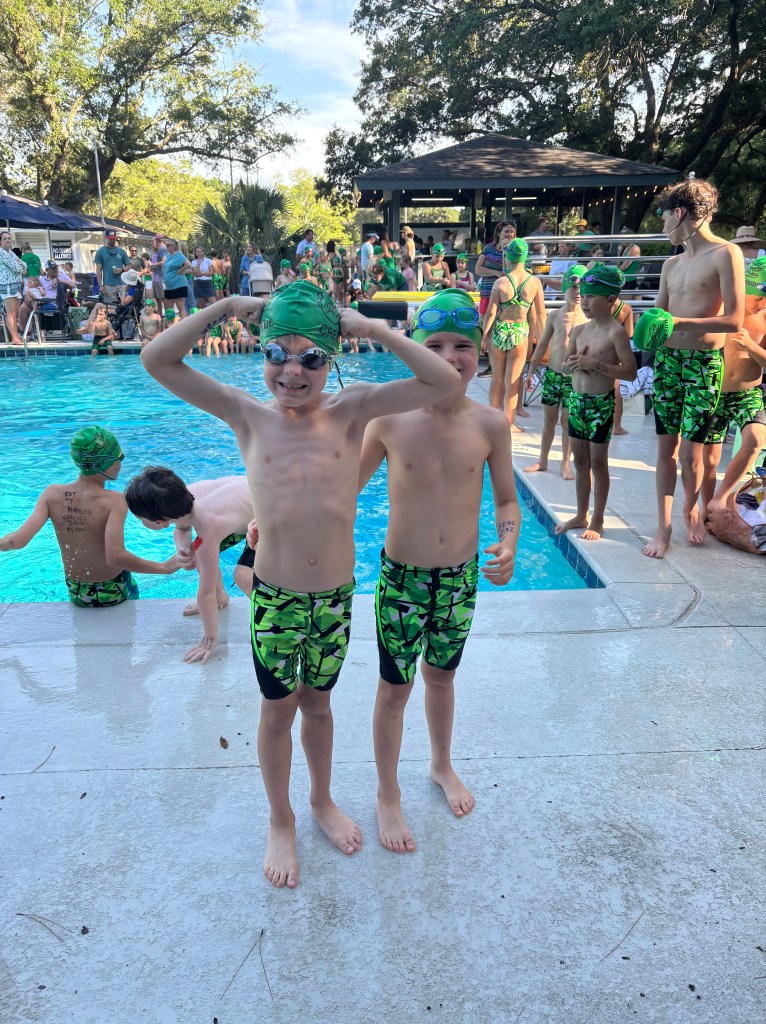
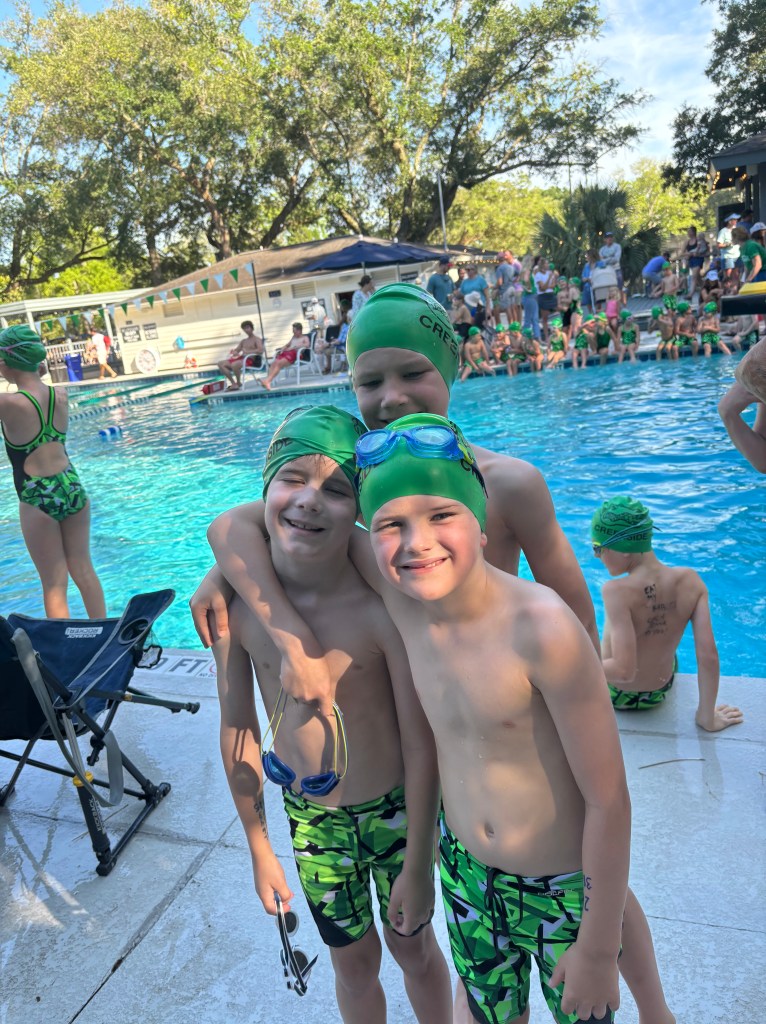
“Cartter and I are like the same person,” I tell Dave. It’s true. I see myself in him so clearly, which is perhaps the biggest reason I say his becoming a swimmer is “a mind-fuck.” I suffered tremendously in the sport, and my identity is seemingly inextricably linked with it. I want things to be different for Cartter, for his suffering to be less. As his coach I want to drive him to succeed, and as his parent I want him to have his own identity that is free from anxiety. To that end, I try not to talk to him about swimming when we aren’t at the pool, but occasionally, the need arises. On the day of the season’s first meet, he confessed to me on the drive to school that he was nervous. “What if I don’t do well?” he said. After the thousands and thousands of hours I’ve spent as an athlete and a coach, and after the terrible stress that I endured as a young swimmer, I’d like to think that I’m more well-prepared for such a moment than just about any parent on the planet, but the truth is I instantly got butterflies. I hated the idea that after all the work we’d done together, Cartter might freak out when it came time to perform. Before I had time to think, I caught myself being dismissive. I said that all his races were 25s and that he did way more than that in practice. I tried to sweep his fears under the rug and act like they were unjustified. I was about to laugh, and I realized that I sounded like my mother. Then, I remembered what I tell all the other nervous kids who aren’t my son: it’s normal.
I talked about nerves the rest of the trip. I told him how scared I used to get before my races and how one time at a meet in Atlanta when I got to swim in the Olympic pool, I conquered my fear. I told him how I thought about my preparation beforehand and how I told myself I was ready. I told him about swimming under Scott Bynum’s name in prelims and how my teammates and I all laughed about the commentator going wild when I blew away my heat. When we stopped at a red light, I looked over my shoulder and told him about Brianna being my energy machine. He blushed and stifled a laugh. I said what I thought were all the right things, all the while hoping that something would land and make Cartter feel better. I was relieved when I got home, and Danyelle told me he ate his breakfast. Then, I was even more relieved when I saw him at the meet. After he won the freestyle, he high fived his teammate next to him. He hung out with the boys in his age group all night and mugged for pictures with his brother. Standing behind his lane before the butterfly, he looked over at me standing on the side and grinned. “Cart-Man!” I hollered, pointing at him, and he grinned again. When he won that race, his teammate was waiting for him at the other side of the pool, shouting “Way to go, Cartter!”
There’s a common refrain I’ve been hearing lately from people around the pool. They say, “He looks exactly like you.” When I think of Cartter standing behind his lane before his race grinning at me, I know what they mean. I can see in my mind a picture of myself standing on a starting block at Wild Dunes, tanned, bent over the edge about to go down and take my mark, looking over to the side with an easy smile. I was eight; swimming was still pure joy; and my life was about perfect. I look just like Cartter. When I see my son look at me that way, I know what love is.
“What about Scotty?” Dave says as he stands up to grab the microphone and start the next heat. “Does he just get nudged out?” It’s a legitimate question and another reason I fear Cartter’s quick uptake of the sport. What if his brother doesn’t want to swim? What if Cartter continues to excel and we continue to bond around the pool, only to leave Scotty on the outside looking in, resenting both of us?
The last thing I want is to damage my boys’ relationship. I’ve long marveled at Cartter and Scotty’s closeness. They are more than siblings or friends; their relationship is like nothing I’ve ever seen. When I say that Cartter and I are like the same person, I mean it in the sense that we are remarkably similar. Cartter and Scotty are different. They’re like two halves of a single person. They do everything together. They say they’re going to live together and adopt children and work in the same place when they grow up. When we travel, they have a way of attaching themselves that I call enmeshing, and people inevitably ask if they’re twins. When we take walks after dinner, Cartter and Scotty go at their own pace separate from their mother and me, talking incessantly, their hands joining as naturally as a perfect stroke entering the water. When Cartter spent the night at a friend’s house without his brother, it might have been the worst night of Scotty’s life. The two are simply incomplete without each other.
I’m very proud of the boys’ relationship, and I wonder about the strain that swimming could put on it. As attached as they are to each other, they’re very different people, and their swimming highlights their differences. Whereas Cartter is the rare kid who makes changes at the drop of a hat and improves by leaps and bounds with each practice, Scotty is more typical. The first time I ever coached him in summer league, he cried that he didn’t understand what to do, and then he jumped in and did a very good impression of a drowning victim. When I fussed at him to make a stroke change during a year-round practice, he took offense. Cartter would have accepted my critique, but Scotty later told me he was embarrassed. When I was saying goodnight, he asked why I did it, and I told him I wanted to teach him properly. I asked it that were okay, and he said, “Not if you do it every day.” While Cartter is winning blue ribbons and setting team records, Scotty is more middle-of-the-pack. I’m not writing Scotty off as a swimmer. He could end up being outstanding, but he doesn’t respond to coaching as well as his brother. Regardless of how he performs in swim practice, I don’t want him to think I care about him any less.
For now, Scotty is content to cheer on his brother. When all is said and done, and Dave and I finally walk away from the score table, Cartter’s won four blue ribbons. Scotty’s won no ribbons at all, but he remains undeterred. At practice the next day, he’s excited that I keep on calling on him to demonstrate skills to the group, and when we race 25s off the blocks, he swims all out and touches first. He asks me afterward why I kept calling on him, fishing for a compliment. More than he wants awards, he wants his father’s attention.
The next morning we’re at the beach on Sullivan’s Island. It’s early in the season. The breeze is cool, and the water is still chilly. It’s flat too, no waves to ride. It’s the kind of day when as children my sister and I would have looked out the window in the living room and disappointedly stayed home to watch TV. I’m second-guessing my decision to come out, and Cartter is wrapping his arms around himself, his intention to go swimming completely evaporated. Scotty is on a mission, though. He lives for the thrill of an ocean swim. “Scotty needs a swim buddy,” says my wife. That’s me. I wade out with him with my arms held out to the side, walking on tip toes to avoid the baby swells reaching my waist. Scotty announces that he’s going under, and when I finally join him in surrender to the cold water, the feeling is the same as when Cartter looks at me smiling before his race.
Scotty swims towards me with a gap-toothed smile on his face. He shows off his freestyle. He lets me hold his feet and guide them through breaststroke kick. He sits on my knee and puts his arms around me. Facing the shore, I can see the house where I grew up. I see the porch where the shit hit the fan. Above it, I see the windows into my father’s bedroom. He’s there, waiting on us to return from the beach. After we shower off under the house, I’ll go up and talk to him. Undoubtedly, we’ll talk some about swimming, and the topic of Mom and T.J. will come up. As adults, Dad and I talk about everything. Bobbing in the water with Scotty, I’m in about the same spot where I once wrapped my arms around Dad’s neck while he body surfed into the shore over and over. I don’t remember it, but he’s told me about it many times.
Scotty’s still sitting on my knee starting to shiver. “Do you remember when your mother and I taught you how to swim in the Creekside pool?” I ask, referring to the neighborhood pool where he still swims summer league. “You used to jump off the wall and swim to us, and we’d keep backing up, and you’d get mad.” He doesn’t remember, but I do.
When we walk back onto the beach, Scotty flings himself onto the sand to warm his body. I ask him if he plans to go back out again, and he says, no, he’s done. I’m glad that I have at least one more summer to be his swim buddy. Soon, I won’t get to hold him in the water anymore, and that makes me sad as I sit on the sand with my arms wrapped around my knees. To my left I notice a coach who worked with me at Hobcaw. I walk over and say hello, and we reminisce about how much fun we had with the kids in those days, how good we felt to have been part of that time in their lives, and how bittersweet it is to have children in today’s very different summer league. If my parents hadn’t inexplicably brought me here thirty-five years ago, the two of us would have never met. I might not have swum at all. But they did, and I did. As a fifteen-year-old, I stood on the porch overlooking this spot refusing to acknowledge the end of my childhood happiness. So much of that happiness came in and around swimming, and so did so much of the heartache that followed. Since then swimming has touched nearly every corner of my life – my career, my friendships, my marriage, and my children. One day maybe I’ll say goodbye to the sport, but when I see my child grinning behind the blocks or beaming at me after a swim lesson in the ocean, I know I’m not ready. I still love it too much.
 The Raging Elitist