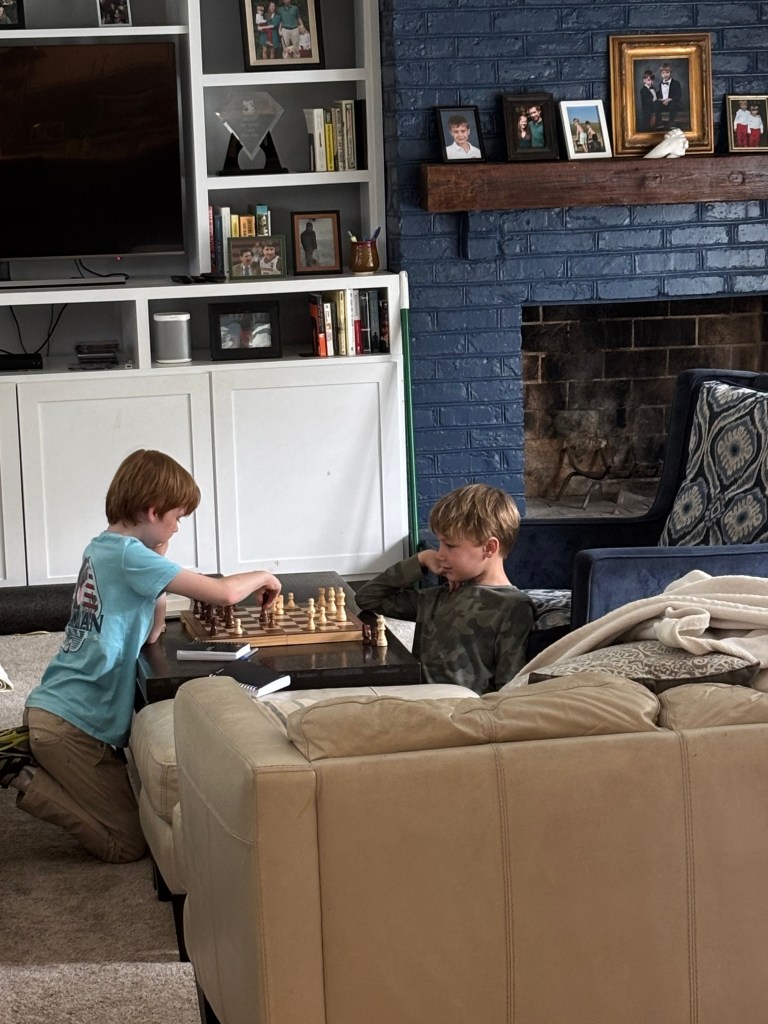
This past weekend I found out that Cartter has been playing chess every Friday at school. “I always play for fun Friday,” he said. We were out to dinner after an afternoon at the park. When we got home, we played a game, and he beat me. I slowed him down twice before he could make a stupid move, but he generally outplayed me, which I found rather stunning. He even went so far as to mock me for a dull move I made in the middle of the game. When it was all over and he repeated his mimicry, I said, “It’s okay for you to say that to me, because I’m your dad, and I love you, and we can laugh about it, but other people might not like it. That’s what’s good about being father and son.”
“I know,” he said. Both of us laughed to the point of tears.
The other people I had in mind were his friends at school, and Cartter was clearly sincere when he said he knows not to abuse them. Schoolmates are like friends on the inside: they rely on each other for survival. Cartter’s gang congregates in the sandbox or at the tether ball pole at recess, and apparently, around the chessboard during downtime in the classroom. These kids surely don’t sit atop the social hierarchy, but they have their place within its structure, their numbers enough to give pause to would-be bullies, and their companionship an indispensable comfort amid a world stripped of freedom. Cartter, like any savvy kid, understands that delicacy is required.
The importance of tact doesn’t go away when the dismissal bell rings either. Time away from school is like a temporary release program. Bad manners on the outside are dangerous. The morning after Cartter checkmated me, we took the boys to a birthday party for a kid in Scotty’s first-grade class. The older brother was one of Cartter’s chess buddies, and when the two of them ran into each other, their genteel behavior was a far cry from the roughhousing and arguing that happens with boys in the neighborhood, where Mommy and Daddy are always just around the corner. The boy spotted Cartter heading for the bathroom and walked over to wait for him. When one of the zipline course employees asked if he needed something, he said, “I’m waiting for my friend.” Cartter reemerged and a big smile spread over his face when he saw Alec standing there, and the pair spent the next two hours in close proximity, talking, laughing, and keeping their hands to themselves. This relationship was not one born of parental convenience or mere proximity. It was something realer and more mature. The neighborhood gang is a luxury taken up automatically amid a world of suburban ease; Cartter’s school friends are a necessity, a lifeline amid a world of captivity. It should come as no surprise they get more respect.
Cartter says nobody wins the chess games at school – the kids almost always run out of time. I wonder how the dynamic might change if there were winners and losers. Cartter’s mother and I were less than sportsmanlike a few times when we went through a chess phase a couple years ago. I’m guessing the boys at school would be deferential to one another rather than risk falling out. Danyelle and I have to play in an open-handed sort of way, where we talk through the board when a player loses focus or gets stuck; otherwise, a certain competitor tends to lose her cool, sometimes refusing to finish, which is a real bummer, because I like getting to the end of a game. There’s something satisfying about the way every checkmate is different despite the board beginning the same way every time. To reverse-engineer it would be impossible to someone who didn’t see the game, but its architects can go over key moves the way golf partners talk through their scorecards in the clubhouse.


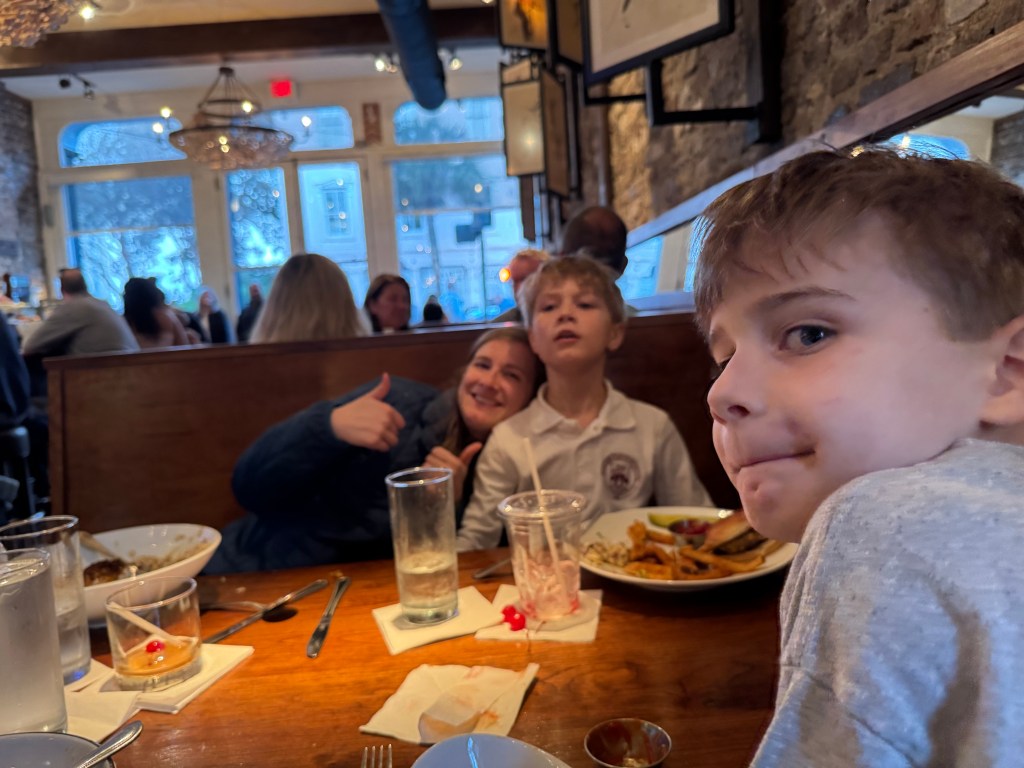
Cartter seems to share my sense of satisfaction with a checkmate board. He was disturbed when he saw our game had been erased by one his mother and I played after he went to bed on Friday night, even more so when Danyelle rushed through a game on Sunday evening with him, frustrated by her poor position and ready for the contest to end. “Why didn’t Mommy try to win at the end of the game?” he asked me afterward. He was in bed. I’d just turned out the lights in his room and was headed for the hallway.
“I don’t know buddy. She gets grumpy,” I said. “I wanna play you next, though. I promise I won’t get grumpy.” The big smile that lit up his face was a lot like the one he shone at his friend at the party, with less shyness. I find myself thinking in the aftermath of the weekend, and statistics bear it out, that chess, like golf, is kind of a dude thing.
Cartter will see his friend again at a sleepover at another boy’s house this coming weekend. “It’s my first sleepover without Scotty,” he said at bedtime the other night. “And it’s my first sleepover with a friend from school. And Jack and Alec are gonna be there.”
“Are you scared?” I asked.
“No, I’m excited,” he said. “We get to talk about all our annoying classmates.” The sandbox, tether ball, chess: useful diversions all, and a fine starting point for the kinds of relationships that make time on the inside tolerable, but every hardened third grader needs friends whom he can trust with some hot gossip, dangerous as it might sound. Somehow, I trust Cartter and his gang will use the right amount of discretion and avoid getting each other into trouble, i.e., they’ll keep the hot goss between them and only laugh at their more insufferable classmates behind their backs.
 The Raging Elitist