Lately I’ve found myself talking very excitedly about my son’s swimming, mostly to my wife, but also to his friend’s father, my physical therapist, my parents, my coaching colleagues . . . basically, anyone to whom my son’s nascent swimming career is even remotely relevant is aware of his budding talent.
“He’s doing that already?” the PT asks while she manipulates my arm overhead, stretching my frozen shoulder capsule nearer to full range of motion.
“Well, he’s going to be a champion,” I joke.
“Oh, you’re one of those dads.”
“Have you seen Breakfast Club?” She smiles and nods. “You’ve got to be number one! Win!” She laughs, but not as much as I would have liked.
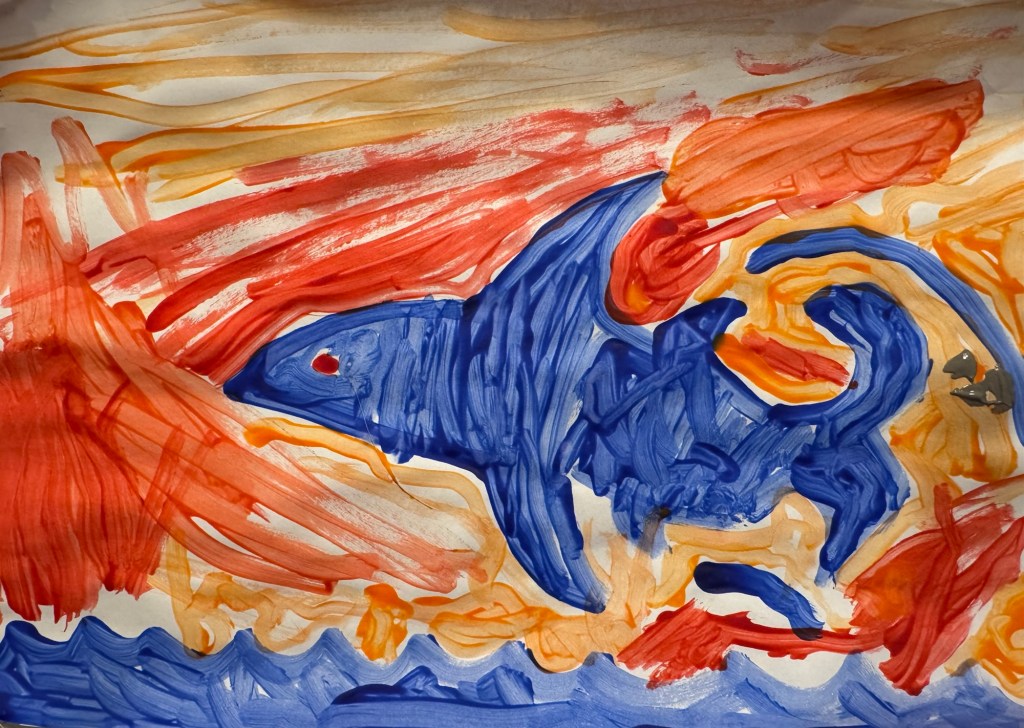
Cartter and his brother Scotty have been coming to swim with my year-round group twice a week for almost two months now after spending the schoolyear’s first semester in a rec program called “minnows.” Minnows is closer to the house, less organized, and totally noncompetitive. Fittingly, the team I coach is called the Sharks. Scotty is still six, and he doesn’t really belong; I dumb the skills down for him and usually dismiss him early, but at eight, Cartter is solidly middle-of-the-pack among the group of older, more experienced kids. He’s getting better quickly too, and I’m a bit shocked by how thrilling it is to oversee his development in a coaching capacity.
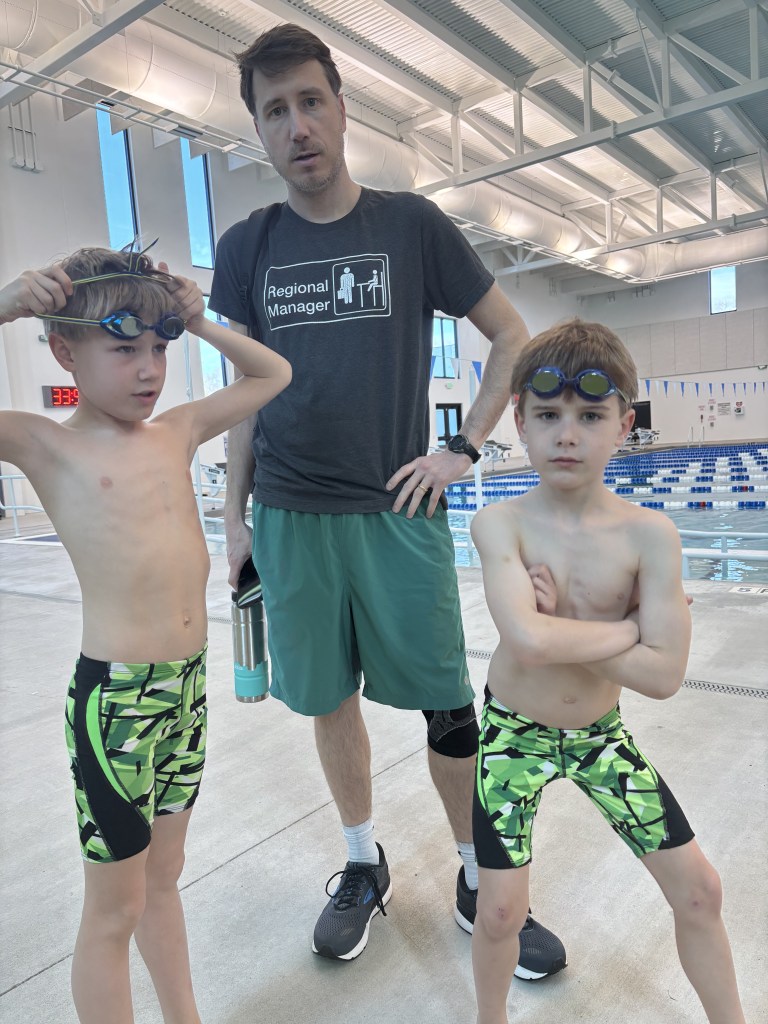
“The kid has a freakin’ motor!” I explain to our neighbor friend when he comes by the house with his son and two daughters. I coached Cartter in summer league when he was five and then again when he was six. Teaching him and the neighborhood kids freestyle alongside college-age assistants at the community pool was joyous to be sure, but it was nothing like what I’m experiencing on the deck now, watching him become an athlete right before my eyes. He’s an age group coach’s dream. Despite his gender, he actually pays attention; he processes information quickly; he makes stroke adjustments; and, most importantly, he never complains or succumbs to fatigue. He has a freakin’ motor, and I’m delighted by it, but when I try to share my delight with our neighbor friend, I see his mind drift as mine so often does when another dad tells me about his kid’s athletic exploits.
“My 8yo’s a butterflier,” I text an old coaching buddy. “He’s gonna fuck summer league up.” Will just taps back exclamation points and in a minute, we’re texting back and forth about old times and a particularly crazy acquaintance named Paul whom we have in common. Nobody really wants to linger on the subject of Cartter’s swimming the way I do, not even his mother. “I just have to say it again,” I tell her. “I can’t believe my son’s a butterflier.” She rejects the idea of signing him up for the 8-and-under state meet in Greenville, apparently in agreement with Scotty, who says, “I don’t wanna spend my weekend like that.” Cartter, on the other hand, is very interested in the prospect of swimming a few races and spending the night in a hotel.
“You’re like, ‘That’s my DNA!’” a fellow assistant coach jokes when I rave to her about what I’m seeing from Cartter at the satellite pool where I run practice. I guess I shouldn’t be surprised. Swimming is in my son’s blood. Outwardly, I’ve always said that I hoped my kids would be into ball sports, but inwardly I’ve wondered if I’m being honest with myself. Danyelle and I have put Cartter and Scotty in baseball and basketball and tennis, but all the while, the boys have watched their daddy go off to his life at the pool. Of course, swimming has garnered more of their interest, and of course, I’m excited. Still, I can’t help worrying.
“Swimming’s bad for you,” my coaching friend Will used to joke. People who really pursued the sport know what he means. Victory in swimming is all about pain, endurance, and separation. It breaks people. Retired swimmers aren’t bound by triumphs or losses they shared but by scars. I don’t know if I want my kids to go down that road, but at the same time, it’s the only one I know. Even as I’ve tried to temper my involvement in swimming, limit how many days a week I spend on deck, avoid travel meets, I’ve been leading the boys toward the sport I’ve chosen my whole life. Sometimes, I wonder if I’m perpetuating a curse.
“It’s like we have bad juju,” Danyelle says when the unfortunate events start piling up. I decided at the last minute to travel to the state meet to be with the team last weekend, and now, a week later, we’re down on our luck. The dog, who is on exercise restriction due to an arthritis flare, keeps crawling under the gate and escaping, her ensuing escapades leading to upset stomach and a badly inflamed right foreleg that can’t bear any weight. Danyelle is very sympathetic to Sammy’s troubles. Tired and in a hurry to get home to take care of her, she got into an accident driving the boys home from swim practice; everyone inside the car was unharmed, but the damage to our brand new vehicle was significant, and of course, I bought us a policy with the highest possible deductible. The idea of juju strikes when Danyelle and I are sitting in the living room commiserating about how to handle the repair, and Cartter manages to conk Scotty in the face with a baseball bat in the backyard (an apparent accident caused by each party’s ignorance of proper safety precautions). Maybe if I hadn’t gone to the meet, Danyelle and I would have been less tired and more attentive. Maybe if I had really cared about the boys learning baseball, they’d know how to handle a bat. Maybe if I weren’t so wrapped up in swimming, none of the week’s atrocities would have occurred.
“I don’t wanna coach Cartter past twelve,” I tell Danyelle once the kids leave the table that night. Swimming obsessed my family during my childhood, dominating our dinner time conversations. Thirteen was the tipping point when my training became the focus of our lives. It was also when my parents’ marriage started showing signs of failing. No doubt my swim scars are worse than most because of the way Mom and Dad’s divorce unfolded. I can’t help but wonder if by choosing swimming, I doomed my family.
Now, I’m leading my family back into the wilderness again, this time as a father and a coach. “Is one of them your kid?” a little girl swimming in a lane with the boys asks at practice. I can’t decide if she’s really just figuring it out or if she’s setting me up. She’s a unique individual, forever talking when I’m giving the group instructions, shouting at me that she doesn’t understand, ordering me to just tell her what to do as we go, constantly demanding feedback. In all my years, I’ve never met a child more intent on dominating my attention than this one.
“Yeah, those two,” I say, pointing.
“Oh, you’re so lucky!”
I let Scotty out early, per his request, so he can do his homework while he waits on his brother, but Cartter motors on. I notice how his stroke is lengthening out, how his recovery is relaxing and his hands are catching the water more quickly, further in front of his body, generating more power in the process. The group drills transition turns, and it’s the first Cartter’s tried them. He gets the basics. When the workout gets to the 100 IMs off the blocks that I’ve planned, I put him next to one of the faster boys and am proud when he pushes him, even prouder when the two of them climb out sharing an expression of slight surprise, panting heavily, covered in the smooth wet sheen of exertion. Later I’ll remark to Danyelle, “Our boy is a fucking racehorse.”
My Head Coach jokes with me over the phone when a kid we’ve been training gets his first “Futures” cut, “I gotta give you credit on Ivan. I know you’re a credit hog.” Every coach likes a little credit. When it comes to my son, though, I don’t know how much I want. I’d rather he win than lose; I’d rather he swim beautifully than not; and I’d rather he learn from me than someone else, but all that presupposes that he even wants to swim at all.
“I liked it,” he invariably tells me after practice. I always call him over to me before he walks out the door to his mother. I want to look him in the eye and gauge his feelings, to tell him I’m proud and put practice behind us before we see each other again at the house. Once when I asked him what he liked, he told me, “I like how I get to use all the energy I have to hold in at school.”
He’s always calm after practice. Faced with my enthusiasm, little bits of laughter spill out of him like water from a faucet. When I corral him with one arm, his whole body is relaxed, and his little boy frame melts into my side. Afterward, he walks away loose with his gear bag strapped to his back, leaving me with the older kids, who glide through warmup dreading what’s to come. Part of me thinks that if Cartter were just a little further along, they’d all benefit from him slotting into one of their lanes and pushing them. Lord knows he wouldn’t back down. The kid’s motor does not quit, and watching it run from the deck as his father and the team’s coach is pure joy. Even with all my misgivings about the past and concerns about the future, I’ve never been more excited to teach a kid about the sport that’s shaped my life. Cartter’s ability paired with his desire feels like a miracle. Somehow, I didn’t expect it, but now that I see it, I can’t stop talking about it.
 The Raging Elitist