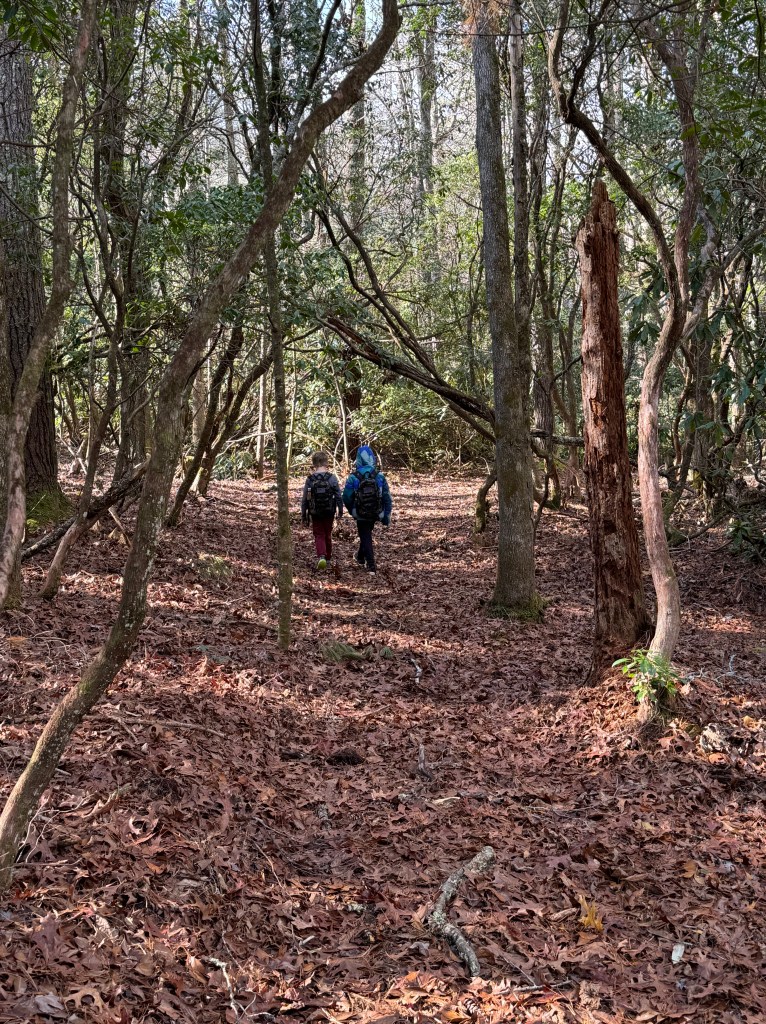
Starting up the Nix Creek trail that wends its way around the headwaters of Sapphire’s Upper Lake, the boys tromp along ahead of me, little camo packs with sandwiches and waters on their backs. Their jackets come off and go back on again as their body temperature fluctuates in the cool November air. The skies are clear, and the trees are bare, their fallen leaves slushing beneath our feet as we make our way further into the woods. As he is wont to do, my 8-year-old Cartter strikes up a conversation: “I ask people at least twenty questions a day,” he says.
“Who do you ask?” I say.
“Whoever I can find.”
Walking alongside him now, I can’t help but feel proud of his voracious intellectual appetite. I don’t doubt that he means what he says. He sees the value in asking questions and pondering the answers he gets in return. I imagine him on the playground at school behaving like Socrates in the marketplace, and I’m amused. I wonder if any of his teachers or classmates get annoyed. Socrates did, after all, get sentenced to death for impiety. Undoubtedly, some people viewed him as intolerably annoying. I don’t want him to be reviled or persecuted, but I can’t help but enjoy the idea of Cartter getting under people’s skin. Adding to my amusement is the fact that he has told me without irony on multiple occasions that he “doesn’t like getting asked a lot of questions.” I can relate.
I remember as a kid savoring the rare moments when I felt unbothered by the probing questions and demands of adults. So constantly was I being tested and ordered about that sometimes, I would sit with my head in my hands and close my eyes when a moment of relief presented itself. I might even cover my ears so that the only sound was that of my blood whooshing around inside me, the only sight the fading bits of light behind my eyelids.
By the time I was fourteen, I was working out in the pool over twenty hours a week; the demands at the elite private school I attended were ratcheting up; and my teachers, coaches and parents all expected me to perform up to the potential they had worked to nurture in me. Pushed to accumulate the sorts of accomplishments that would endear me to prestigious universities, the students and teammates that might have been a community were instead a sea of competitors. My days were a hectic rush that saw me leave the house at 4:30 a.m. and return at 8:00 p.m., and I was almost never alone during the hours in between. When a fleeting moment of quiet did come along, I closed my eyes and sank into myself, longing to stretch time the way a person longs to slow the clock after waking minutes before the blare of the alarm.
These days, instead of trancing out with my eyes closed and my head in my hands, I use breaks in the day’s demands to write. I don’t have such a strict hourly schedule as I did in high school, and I have far fewer bosses burying me in expectations, but the time I get to myself still never seems like enough. Joseph Epstein and David Brooks, both writers I admire, claim that they spend three hours a day writing. It seems like I ought to have that much time at my disposal, but more often than not, I just don’t. There are plenty of reasons why – appointments, emails, stacks of bills and never-ending housekeeping chores – but sadly, when it comes to assigning blame for my inability to sit at the keyboard and produce, the kids are the easiest target.

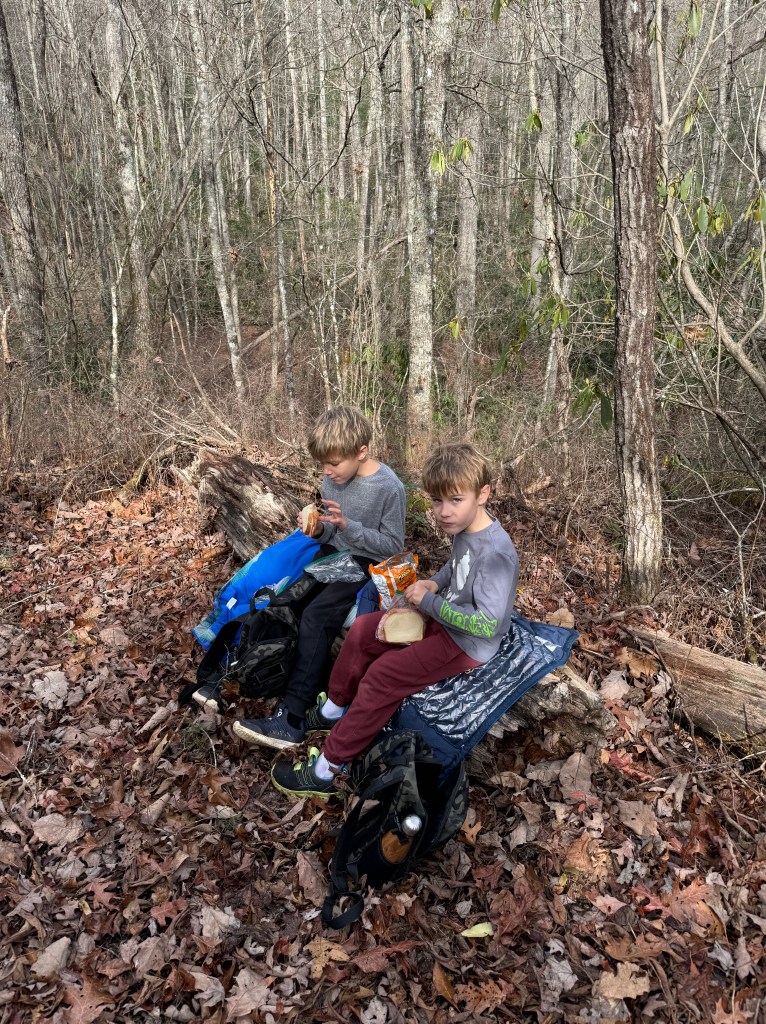
Unlike Cartter proclaiming his distaste for being asked too many questions, I realize the irony in my resentment of him and Scotty. The boys are at once my muse and my writer’s block, their company a fount of ideas and a desert of distraction. Oftentimes, I’ll be writing a story about them and simultaneously dreading the moment they’ll eventually come barging through the door. It’s the same kind of dread I once felt about the alarm in the morning or the first bell at school. Caught up in egotistical notions about the writers who are further along than I and the desire to be published in the right kind of magazines and journals, I’m driven to achieve daily wordcounts and regularly complete pieces. Thus preoccupied, Cartter and Scotty’s presence, with all its explosions of noise and stubborn inattention to my wishes, is like a sudden wave that crashes into my seashell of solitude, leaving it strewn with Leggos, half-eaten food, and dirty laundry. Not surprisingly, viewing the subjects of my chronicles this way doesn’t yield much good work. It’s only when I get away from the computer screen and listen that ideas come. Setting aside my obsession with achievement and status, the boys become an inspiration. Instead of startling me from my self-absorbed reflection, their words fill the silence like birdsong amid the morning light.
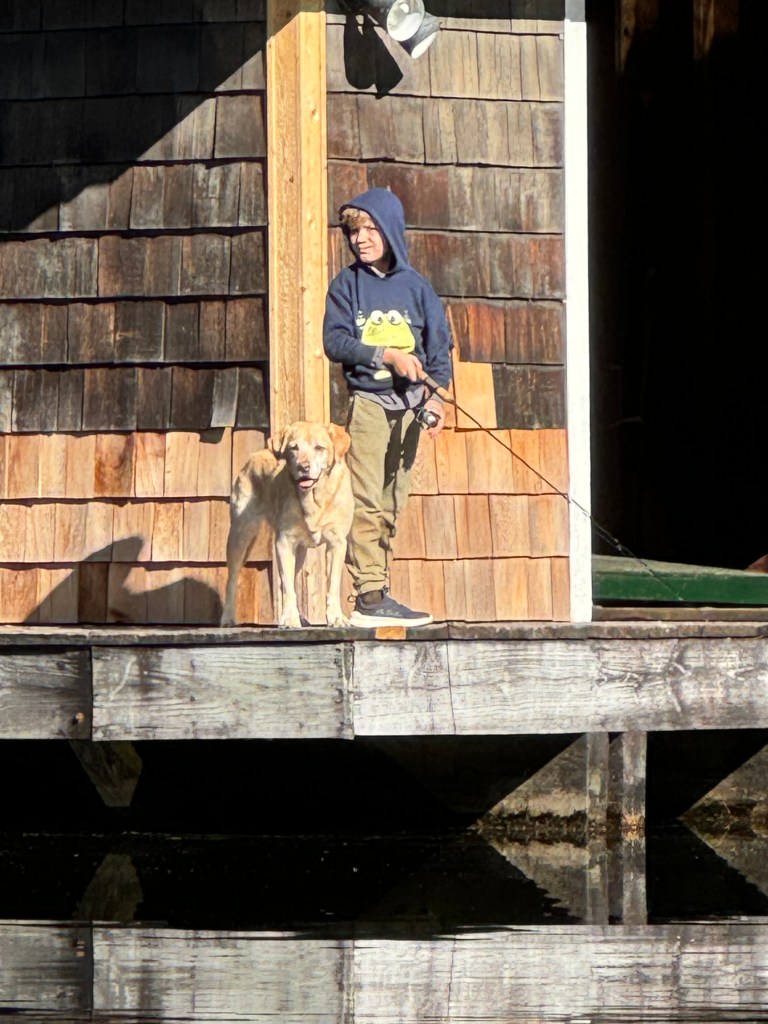
When we return from our hike along the Nix trail, Cartter and I take the little bass boat out on the lake. In the minutes after reeling in a perfect little twelve-inch brookie, Cartter pauses his rhythmic casting, and his thoughts turn to existential matters: “Why did God make fish?” he wants to know. “Why did he make us? Why did he make all this? Was it like, his art project?”
Cartter’s hunger for knowledge isn’t limited to profound moments like those experienced in virgin forest or face to face with the magnificence of a young brook trout pulled from dark, icy waters either. Sprawled on the floor with the Sunday comics spread out in front of him in our living room, he confronts his naivete concerning simpler matters: “Daddy what’s ed? E.D.?” When his brother rushes in to join the interrogation, Cartter explains while pointing to the strip, “It’s a sickness. It says right here, ‘There are little blue pills for that.’”
If I could place Cartter’s questions into the broadest of categories, there are probably two main kinds: those I don’t know how to answer, and those I don’t want to. He asks me things like, “Who invented water? What is it? Why does the ocean have salt, and rivers and lakes don’t?” He’s curious about “the other babies in Mommy’s belly. What would they be . . . I mean if Mommy stopped taking the no babies pill? What if me and Scotty were someone else?”
Sometimes, his questions are oddly specific: “What if Ben Franklin invented stuffed animals? What if you invented stuffed animals? What would you do then? You couldn’t just do nothing; you’d have to make stuffed animals. What if you were a robber? What would you do then?” Here, for once, something I might know how to answer correctly: If I were a robber, I would rob people. “Good answer,” says Cartter.
Cartter’s mind, as any thinking person’s surely must, often veers off into the realm of morbidity. The dark thoughts he there encounters he poses to me as still more questions: “How would you want to die? No, it can’t be in your sleep. What would you do if you were falling over a waterfall? What would you do if you didn’t exist? What if the evil doll from Self (some Disney-produced nightmare) comes out of my closet in the night? What if it does?” Upon my insistence that he think about something else, he tells me, “I’m not in control of my head. It pushes its own buttons, and I can’t push back.”
Cartter’s little brother Scotty is not so obsessed with hypotheticals and prefers to conduct his listeners to the tune of binary questions: “Madeline left her shoes at school. Is that dumb or not dumb?” or questions with concrete answers: “Bob has six pencils, and Tara has five. How do you correct it? How do you make them the same?” The latter example he apparently borrowed from a schoolbook about an alien, Zots Learns to Share. Originality is not a concern. Amusement, both his and his listeners, is.
A boy of some musical taste, Scotty enjoys an array of sophisticated composers from Chopin to Sun Ra to Duke Ellington. He’s unafraid to serenade his mother and me with all the songs from his first grade Christmas production Simple Gifts,using a sweet falsetto for the “angel’s song,” that brings both Danyelle and I near tears: “Shepherds, listen to our song! Listen to our heavenly joy!” Most of the tunes are derived from “Gloria in excelsis Deo” and “Appalachian Spring,” and when I pick them out on the piano, he asks with eyes wide and serious, “How do you know that already?” Then he proceeds to accompany me, singing unabashedly that “A child is a gift from God above.” Standing next to the piano looking me in the eye, his whole being in the moment, ready for whatever comes next, I find his easy acceptance of the divine remarkably convincing.
Far too often I skip family outings, let Danyelle lead the boys through their chores without me, or leave Cartter and Scotty to their own devices while they prepare for bedtime, opting instead for the privacy of the den, working on an essay that likely isn’t very good. Even when I do compose something I think worthy of my brilliant talent, it’s only a facsimile of the truth about the time I spend with Cartter, Scotty and their mother; these are, after all, just words. Cartter nicely sums up the way that I miss the moment by fixating on egocentric desires and distorting my experience of time. When his mother and I lament the passing of the Christmas season on Christmas Eve, finally taking a second to notice the tree all lit up in our living room and wishing we could go back to the start and do it all over again, he voices his dismay with our outlook in typical fashion: with a question. “Why do you guys want to go further away from Christmas?” he says. “It hasn’t even gotten here yet.” Of course, I have no good answer. In all their youth and exuberance, the boys have a fresher, dare I say superior way of viewing the world than I do. Certainly, they ask better questions.


 The Raging Elitist