Rounding the bend on Scotland Drive each evening on my way home from the pool, the twinkle of the lights strung around my neighbors’ trees and shrubs arouse no feelings of Christmas cheer, nostalgia, or grinchy bitterness. I look left and right, hoping for something to well up inside me, and I come up empty instead. Approaching the house, I see the same icicles we’ve hung along the gutters for years. Inside, another Christmas tree bears the same ornaments as the ones that came before it. I barely noticed Halloween and Thanksgiving this year, and I can’t help but wonder, has Christmas become routine? I must be delusional.
Two years ago, I wrote about how my quest to make Christmas perfect for the kids led to an angry outburst when I accidentally coated the two of them and myself with concrete mix. Like an idiot, I thought the fine gray particulate was sand and was trying to use it to fill the paper bag luminaries that line our neighborhood’s streets on Christmas Eve. Back then, Danyelle and I struggled with hanging lights outside and with getting the tree through the front door and into its stand. Scotty was still just four. He and his brother were seeing Christmas movies for the first time: Elf, A Christmas Story, A Muppet Christmas Carol. We took them to visit the “North Pole” display at the ritzy Charleston Place shopping mall downtown. We got pizza at a hole in the wall I used to frequent in my early twenties called D’Alessandro’s afterward. We drove through the light show at James Island County Park after dining on a bag of McDonald’s on the banks of the Ashley River at sunset. The kids were like putty in our hands, and we nervously molded their earliest Christmas memories, clumsily carrying out what we took to be the necessary rites, stumbling across some genuinely beautiful moments as we did so.
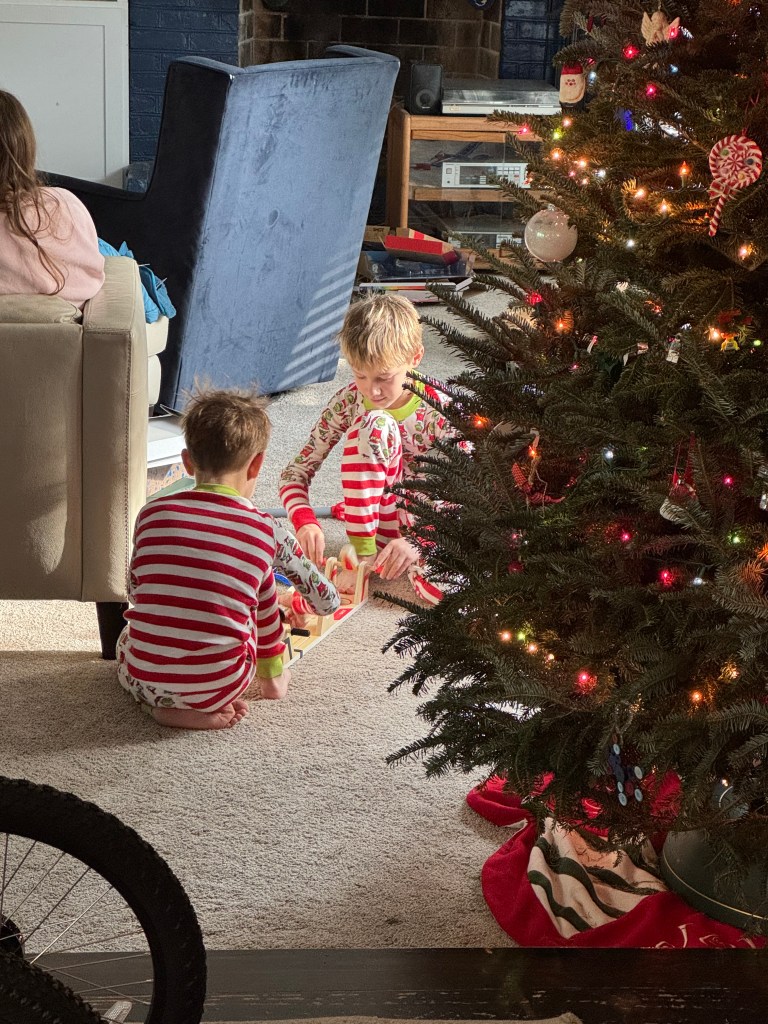
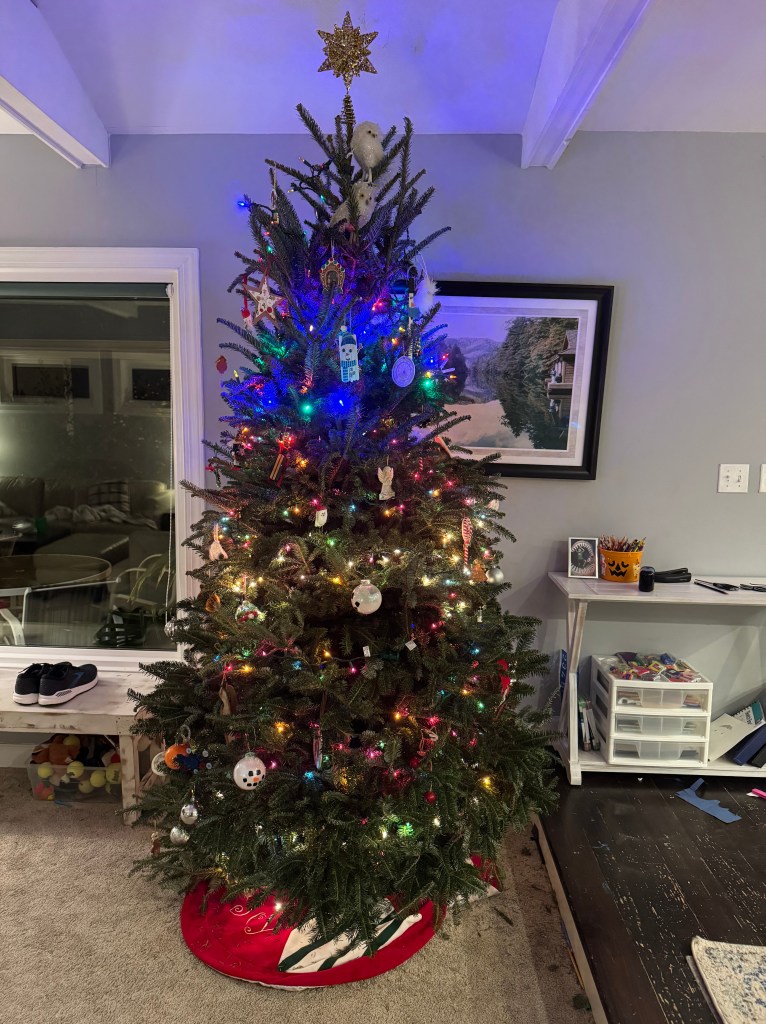
In the time that’s passed between then and now, Danyelle and I have grown more accustomed to our seasonal chores. With her brother’s help, Danyelle strung the icicles in the dark this year. She and I got the Christmas tree through the door and into its stand without the least struggle; there wasn’t even a single pine needle dropped along our path. We hardly had to think about what Santa’s bringing the kids: They need new bikes, and Danyelle picked out an orange ten-speed for Cartter and a black twenty-incher with handbrakes for Scotty at a nearby shop. The two of us agreed on their procurement over the phone, and the pair is now sitting in the shed where I once doused Cartter, Scotty and myself with mortar mix. We’ve passed on the light show thus far, and it’s not likely that we venture into Charleston Place either. The basic requirements of family Christmas are fewer and easier than we once thought, and they’re accompanied by the same lack of feeling as are my evening trips past the neighbors’ Christmas lights on the way home from swim practice.
The kids take it all for granted. Of course, there will be a tree and lights. Of course, the “elf on a shelf” will write them notes in calligraphic handwriting for their amusement each December morning (their mother’s work. There are two elves this year, brothers). Of course, Santa will come, and of course he’ll oblige their wishes. The flipside to Danyelle’s and my drudgery is the boys’ entitlement. No longer are they putty in our hands, “looking at us with eyes like saucers,” as I once wrote, melting our hearts with their impressionability; they have their own well-formed ideas about the way things ought to be now. Danyelle and I took them with us to the tree lot, and they argued with each other about which specimen we should take home, pitching their preferred evergreens like shrill little salesmen: “Look at this one! This one’s only a hundred and thirty-five dollars! Oh, let’s get this one!” Such was the shamelessness of their exclamations that when I mentioned my distaste to Danyelle, she said matter-of-factly, “I know. That’s why let’s just pick one and get out of here.” My wife, the believer, the maker of Christmas magic, reduced to cynicism by her own embarrassing brood.

At eight-and-a-half, Cartter is over sixty pounds now, a head taller than his brother, his shoulders noticeably broader, and his burgeoning physical maturity makes missteps like loudly announcing price tag numbers at the tree lot a little bit more uncomfortable. One wonders if, perhaps, this child shouldn’t know better. In such cringe-inducing moments, I generally strive for restraint in my response, lest I escalate the scene my son is unwittingly making. A private lesson on humility seems to me aesthetically and educationally superior to a public humiliation, but sometimes the offending behavior is so disagreeable that I find myself teetering on the precipice of rage, thinking that a display of righteous anger might be appropriate. See Cartter telling me, “No.” Nothing sends my blood pressure soaring quite so quickly.
This creeping habit of Cartter’s has been years in the making. For instance, Danyelle and I have long endured his nightly refusal to take a shower. “But I went first last night,” he’ll say, or, “But I’m scared to go back there by myself.” A stern rejoinder (and possibly an escort into the scary hallway) is enough to squelch these sorts of debates, which happily have no audience outside our family. As much as I hate repeating myself on these occasions, the fearful reluctance my commands run up against is the most tolerable form of Cartter’s insubordination. Lately, Cartter has added a more casual defiance to his repertoire, one apparently born of a growing sense of autonomy and bolstered by the presence of friends. He likes to trot it out when his and Scotty’s little pal Bennett is over at the house, like when I ordered the three amigos to take their boisterous noise outside, and he said cooly while hanging upside-down over the back of the couch, “No, we’re just playing this game in here.” That little beauty sent me to Danyelle’s and my bedroom where I practiced breathing techniques until the boy’s mother fetched him for me. This kind of offhanded dismissal does not arouse sympathy like Cartter’s pitiable refusals to dare the empty hallway to the bathroom at night. Rather it tempts my rageful impulses to the point that a moment alone is required. It still isn’t the most infuriating form of Cartter’s mindless disobedience, though. That would be outright public scorn, a treatment his mother and I suffered at his most recent rec league basketball game.
His team losing badly, Cartter was out of the game when it happened, kneeling on the floor, sitting on his heels across the court from the parent bleachers. Rather than take a spot on the nearby bench alongside his three teammates, he’d opted to stick next to his brother, who was lying on his stomach near the baseline, resting his chin in one hand, holding a pencil in the other. Feet in the air and ankles crossed, Scotty was the picture of serenity stretched out on the hardwood looking down at the sketchpad he was using to keep score. As the opposing team stretched its lead from 10-2 to 18-2, Cartter sulked in exasperation, and I feared that my two boys might be drawing some unwanted attention from my fellow parents. The taller, broader shouldered one wearing the number eleven jersey was of particular concern.
Granted, Cartter was in a frustrating position – on a team full of spastic ball hogs and with a practically nonexistent coach – but there’s no excuse for cheering opponents’ missed shots or releasing a growling sigh after yet another empty trip on offense. At halftime, after watching him be the last man to the huddle, Danyelle and I waved for him to come over to the bleachers for a word. He signaled his disdain with a firm headshake, at which point I stood and started toward him. I made it about a third of the way along the sideline before he broke down into what might best be described as a tantrum, twisting his face into an expression of agony, wildly waving me off with his hands, and lowering his torso toward the floor in panicked insistence that I stay away. Confronted with this horrifying insolent display, I did the only sensible thing available to me, which was to avoid looking at any of the other parents in the bleachers as I returned to my seat, and to send the boy’s mother to make initial contact. She sent him over to me, and he stood above me fighting to keep his eyes dry while I spoke to him from my front row bleacher seat.
In years gone by, Danyelle and I addressed some of the boys’ bad behavior around Christmastime with reminders that Santa is always watching. They’d start fighting and making a ruckus in the house, and we’d say, “Don’t you want Santa to come?” in the unavoidably condescending tone that accompanies such a question. At the very least, it bought a tiny moment of silence as the little hellraisers pondered the threat. I haven’t posed that question once this year. Cartter and Scotty need more now. When my son publicly humiliates me, his mother, and himself, and stands before me afraid, I can’t look him in the eye and give him a line about Santa Claus. He doesn’t need lies, or threats, or bribes; he needs direction. “You’ve gotta stop pouting, bud,” is what I told him. “And sit with your teammates, okay?”
On the ride home, the whole family endured a lecture about what it means to be part of a team, and Cartter was humbled and saddened by the fact that I was “really disappointed in the way he treated his mother and me.” Oddly, the lights on our street seemed to have some of their old magic as we made our way home.
The idea that Christmas could be routine when I have a 6 and an 8-year-old in the house is delusional. It’s selfish too. Yes, Danyelle and I are better at managing our calendars and the chores that come with the season, and it’s true that the magic of Christmas isn’t new to the boys anymore, but to call it all routine is to lose sight of how much Cartter and Scotty have changed in the last year, to discount the few Christmases we have left while they’re still children. So too is it selfish and delusional to obsess about whether they’re growing spoiled and to be frustrated when they don’t know how to act. The anger I feel in response to their missteps has as much to do with my own ego as anything else. Like the Oompa Loompas once said: “Blaming the kids is a lie and a shame. You know exactly who’s to blame: THE MOTHER AND THE FATHER.”

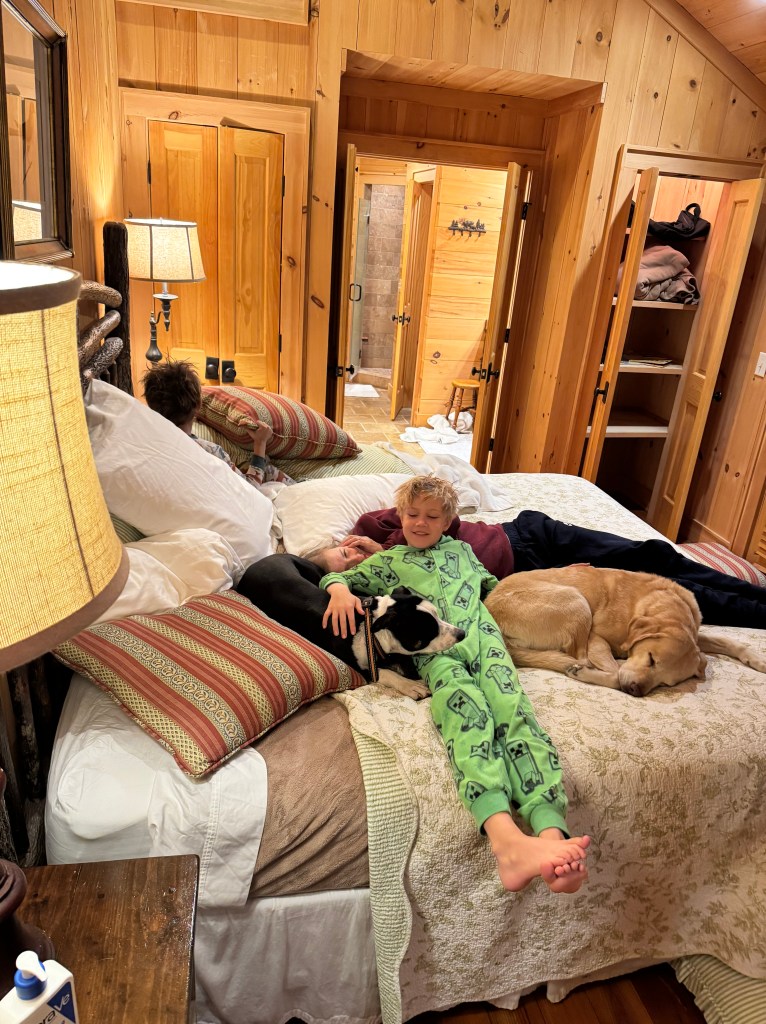

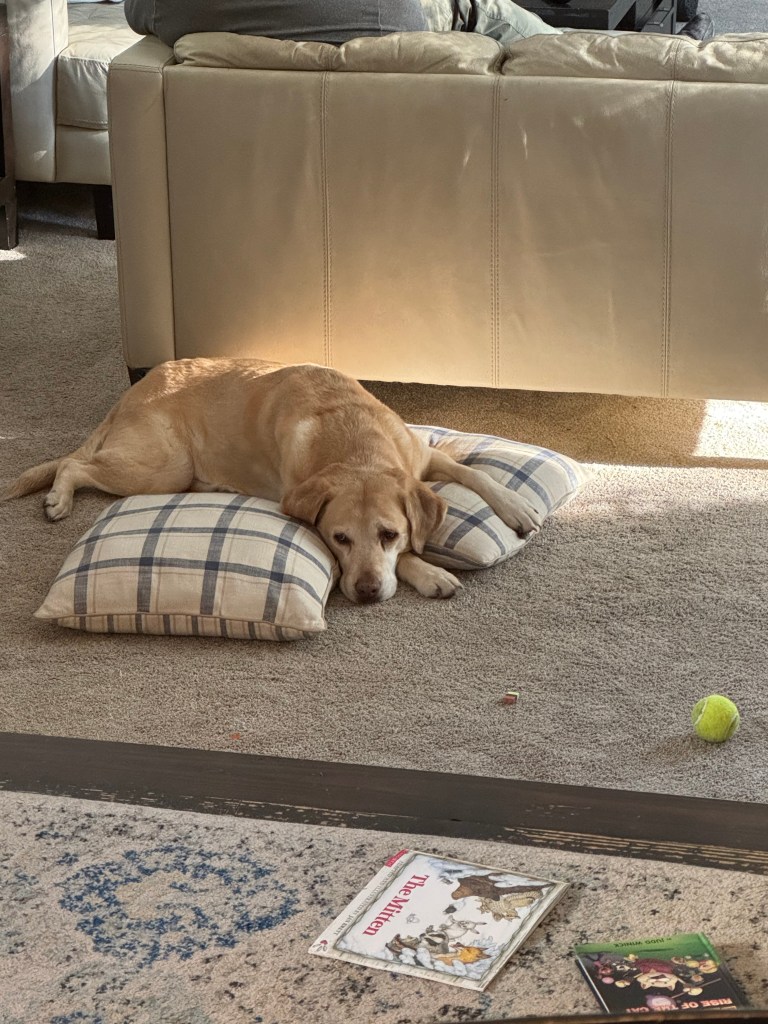
The basketball game proved to be a turning point. We dragged the kids to three Christmas parties over the course of the weekend that followed, the final one culminating in the Mount Pleasant parade, an event we’ve always avoided in the past. The boys were thrilled. They sat right up front, and each came away with a bag of candy. The dog ate it all in the night, and then, after puking it up the next morning, ate it again. Sammy has no trouble getting in the spirit. She doesn’t take things for granted. Compared to me, the kids don’t take much for granted either. After they spent about five minutes decorating the tree, covering a small patch of it in ornaments, they ran and got their friend to show him. “Here it is,” Cartter said proudly motioning to it with his hands like Vanna White standing next to a solved puzzle. He might slip up and mistakenly tell us, “No,” sometimes, but he also spoils us with his earnest thanks nearly every day, like when we fix his meals for him, and he says, “Thanks for making dinner, Mommy. Thanks for making dinner Daddy.” His brother always echoes the sentiment. I fret about entitlement, get angry over disrespect, and fall into cynicism about Christmas, but the boys are filled with reverence, both for the season, and for their mother and me. Of course, Santa is coming, and of course, that’s what they expect. They’re good boys. I can’t wait for them to get out of school and to spend Christmas with them, and I relish the season’s most wonderful gift, that feeling of slipping out of the illusion of routine as if slowly waking from a dream.
 The Raging Elitist