Driving away from the carpool line on a Friday afternoon in early November, the conversation quickly landed on the topic of “manning up.” Upon alighting in the backseat, our first-grader Scotty told of how he had forgotten his lunchbox at recess, and how rather than letting it remain at school overnight for the umpteenth time, he recognized his carelessness and addressed it, asking the teacher for permission to retrieve his misplaced property from the playground before dismissal. “That’s good,” I said easing the minivan past all the inbound carpool traffic. “You manned up. You’re like a little man.”
Of course, Scotty, who by this time was seated directly behind me in his booster seat wanted to know, “What does that mean?”
“It means you had a problem, and you faced up to it even though it was probably a little scary. That’s being a man.”
Judging from their reaction, my boys, who are keen on being big, had never really contemplated “being a man.” I was pleased when my introduction of the idea was met with a brief moment of silence. Then, Scotty’s older brother Cartter, the youngest in his third-grade class, chimed in with quiet confidence, “I manned up today too.”
“Oh yeah?” I asked, eager to hear what masculine feat my more fearful son had managed. “What did you do?”
“I had to go to the bathroom,” he said. “And I raised my hand and asked to go.”
“That’s good. You guys are both getting pretty mannish.”
Turning left at the stop sign, released by the crossing guard from campus, I was tickled by how our Friday afternoon was beginning. Scotty hadn’t forgotten anything at school, Cartter wasn’t hoarding his pee, we’d had a nice little talk about it all, and the best part was that these small successes were making it remarkably easy for Danyelle and I to keep our little secret a while longer. With newly discovered notions of manhood percolating their impressionable minds and the snacks prepared by their mommy occupying their attention, the boys didn’t notice right away when we headed for the interstate instead of the bridge that leads to our home on the other side of Charleston Harbor. We made it almost two miles past that fateful fork in the road before Scotty finally looked up from his snack and asked, “Where are we going?”
I answered him as if it were nothing, as if I were telling him we were running a quick errand: “The fair.”
“Really?”
“Yeah.” The quiet that ensued was as pleasing as that which followed the boys learning the term, “Man up.” There were no joyous exultations, no high fives, not even so much as a grinning exchange of looks. Just silence. Heading west on Interstate 26, the boys processed the unexpected turn their Friday afternoon had taken and resumed their workmanlike snacking, mannishly stoic even as an aura of excitement filled the interior of the minivan.

Rumbling across the pocked field toward a parking spot along the perimeter of the fairgrounds, I hummed the tune from Templeton’s gluttonous romp in the animated film Charlotte’s Web: “A fair is a ver-it-a-ble smorgasbord, orgasbord, orgasbord, after the crowds have ceased.” Selfish, yet kindhearted, Templeton the rat was always my favorite character in the screen adaptation of E.B. White’s classic children’s novel. None of the other animals are quite so human or so entertaining as he. When Templeton does Charlotte and Wilbur a solid in exchange for the opportunity to indulge his lusty appetite at the fair, one can’t help but sympathize: “Each night when the lights go out, it can be found, on the ground, all around. Oh, what a ratly feast!” The smell of fried dough and powdered sugar, the blinking multicolored lights, the shrieks of joy and terror, the exchange of small bills, the games of skill – very few things in life are quite so intoxicatingly irresistible as the fair. People from all walks of life are sure to be there, every one of them drawn by something akin to Templeton’s desire to fill himself to the brim while he still can.
Of course, the rides, those towering testaments to our zeal for entertainment, are the most obvious draw. As someone who’s always been fairly content with the mundaneness of life, I’m fascinated by the lengths to which people will go to escape. To erect these massive structures only to break them down again two weeks later, to shell out good money for the privilege to stand in line and willingly surrender to what in some instances could easily be deemed torture – I share the impulse, but I’m also repelled by it.
The first time I went to the fair over thirty years ago, I was scarred for life by what was supposed to be a kiddy ride. I went on it with my father, two of his friends, and an older boy. The five of us squeezed into a pod made up to look like a giant strawberry, packed so tightly that we had to fold our shoulders forward to fit on the semicircular bench against the berry’s curving wall. A metal disc like a pizza tray was mounted on a pole in the center of the chamber, and once the door shut and all the strawberries started their orbit, the other riders in my cabin grabbed this disc and began turning it with determined, testosterone laden effort. The world outside the small window blurred. I was pinned against the wall, reaching for the disc in a lame attempt at resistance, nauseated and crying out in panic, “Please! Please stop! I wanna get off! Please!” But nobody stopped. They laughed, my father included, and continued turning the wheel with all their might. At the end of the ordeal, when the spinning ceased, I paused before stepping back down on the ground, cheeks wet with tears, stupefied at what I’d just endured, and the ride operator, an older black man who must have heard my horrified screams said to me, “Whatsa matter kid? Cat got your tongue?”
Walking through the gate with Danyelle and the boys, this was the first ride we passed. The egg-shaped pods were repainted to resemble dragons instead of strawberries, but I immediately recognized them as the hellish chambers from my childhood. One in particular grabbed my eye, and I wondered, “Could it be . . .”
At forty years old, letting go of control is still not a strong suit; I’m about as afraid of rides now as I was in my boyhood, but I have managed to overcome my fear in a very few instances. At the last fair I attended before this most recent one, a little over a decade ago, I dared a ride called “The Inferno.” A massive pendulum hanging from an A frame, riders are seated in the clawlike ring that hovers above the ground at its base. Once everyone is locked in, the claw begins to spin, and the pendulum to swing, gently at first, until after three or four trips back through the center when the claw goes sailing above the peak of the frame. The apex of the biggest swings and the ensuing descents are a seemingly infinite moment of pure terror – the total loss of control as your body departs the earth and becomes subject to this evil invisible force more powerful than anything imaginable. The feeling is the opposite of the false sense of normalcy that inhabits the cabin of an airplane hurtling through the stratosphere at hundreds of miles per hour. It is, to the contrary, perfect, brutal exposure to multiples of demonic gravity, and it is absolutely horrific. Standing in line for The Inferno all those years ago, I thought I might wet myself. A 12-year-old girl I coached on the swim team was in front of me, and her eyes gleamed devilishly as she stifled nervous laughter at the thrilling horror we were about to experience. Once firmly in the clutches of the demon ride, I yelled, continually turned my head so as to keep my eyes fixed on the ground, and ultimately managed to keep my underwear clean.
Like the strawberries, The Inferno remains a feature at the fair, and on this recent trip I stood and watched as my fellow patrons submitted to it, noting the exact moment in the pendulum’s arcing path when someone inevitably and involuntarily exclaimed, “Oooooh, Shit!” The boys were in line for a kiddy coaster, and I pondered what they might think of this ninety-second nightmare. Nowadays, The Inferno has an unholy cousin, aptly named “The Beast.” Its pendulum swings 180 degrees over the peak of the frame, pointing straight up to the heavens and suspending the riders held in its spinning claw upside-down before completing a 360-degree arc. As I sat watching the lesser of the two evils, I heard the shrieks emanating from the epicenter of terror that is The Beast. I entertained the idea of strapping into the Inferno with the boys, but as I did so, it felt a lot like I was pretending.
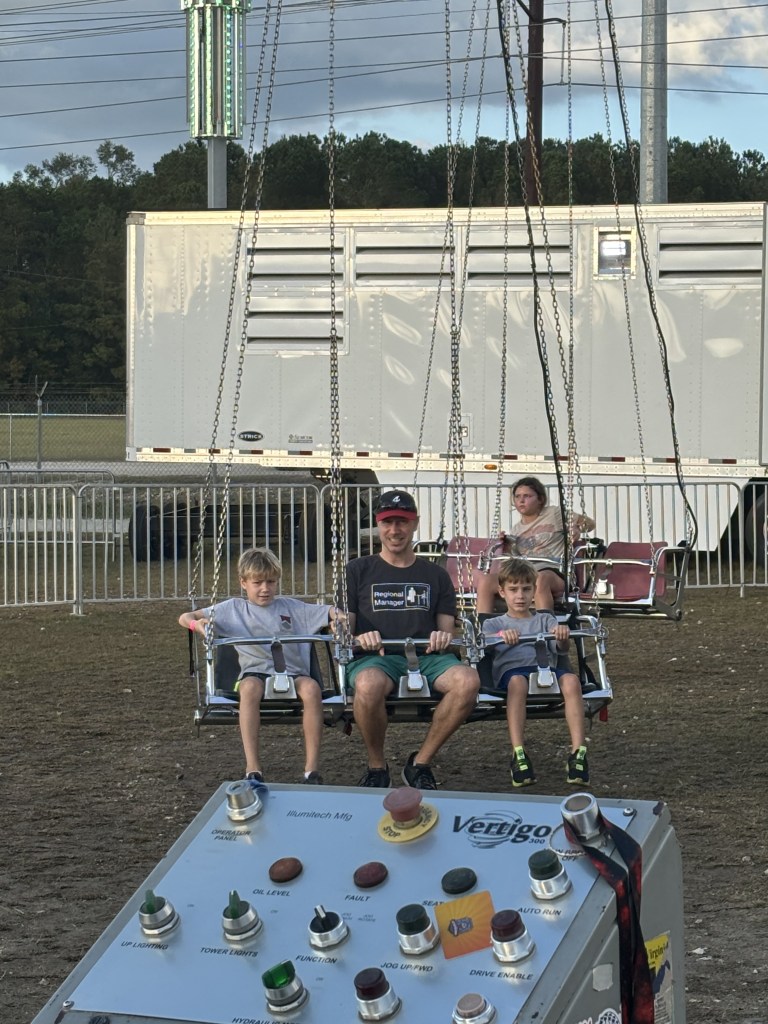
Cartter shares my general anxiety about rides, and his brother Scotty, who is, at six, about the most easygoing person I know, seemingly afraid of nothing, has an amusing and endearing fear of heights. When the three of us went on a ride called “Vertigo” together, a swing that simultaneously lifts and extends its arms as it twirls its passengers around in concentric circles, Scotty remarked, “Oh my God! I’m so afraid! I’m so afraid!” Meanwhile, surprised by the centrifugal force, I felt the beginnings of panic stirring within me as my hat flew off my head. Cartter coped by closing his eyes. On the Ferris wheel, each of the first few times that our tub neared the top, Scotty tensed up and sprang to his feet, almost as if preparing to leap to his death rather than face the awful specter of dangling from the ride’s highest point. Watching as a few brave souls at a time locked themselves into The Inferno’s awful grip, fingering a sore spot on my neck where a bulging disc threatened to blossom into sharp radiating pain, I felt a mixture of fearful longing, disappointment in myself, and relief as I officially crossed the two satanic pendulums off the list of rides upon which to man up. Better to reach for some lower-hanging fruit first than to overextend and ruin the evening in the process. Even when seeking excess, moderation is best.
The sun set, and darkness began its soft descent upon the fairgrounds. After a panic-inducing wait for a ride on a swinging boat that saw Cartter’s eyes well with tears and the three of us bail out at the last instant, the boys tested their mettle on a giant slide, the “Kite Flyer,” and the Gravitron. Thank God we didn’t make it onto that boat. Even for the riders sitting in the middle rows (all adults), who weren’t subject to the most dramatic swings, it was obviously trauma inducing. The boys and I narrowly missed being the last to board, and after the ride operator relatched the chain in front of us, before I realized what was happening, both Cartter and Scotty turned and fled to their mother, much to my relief. The boys were mildly amused by the slide; Cartter opened his eyes and matched his brother’s gleeful expression midway through the kite ride; and after exiting the Gravitron – a ride which old strawberry scars prohibit me from entering – they informed Danyelle and me that it was “awesome.” With their spirits running high and me eager to get back in the action, I led them toward the final terrifying test of their newfound manhood.
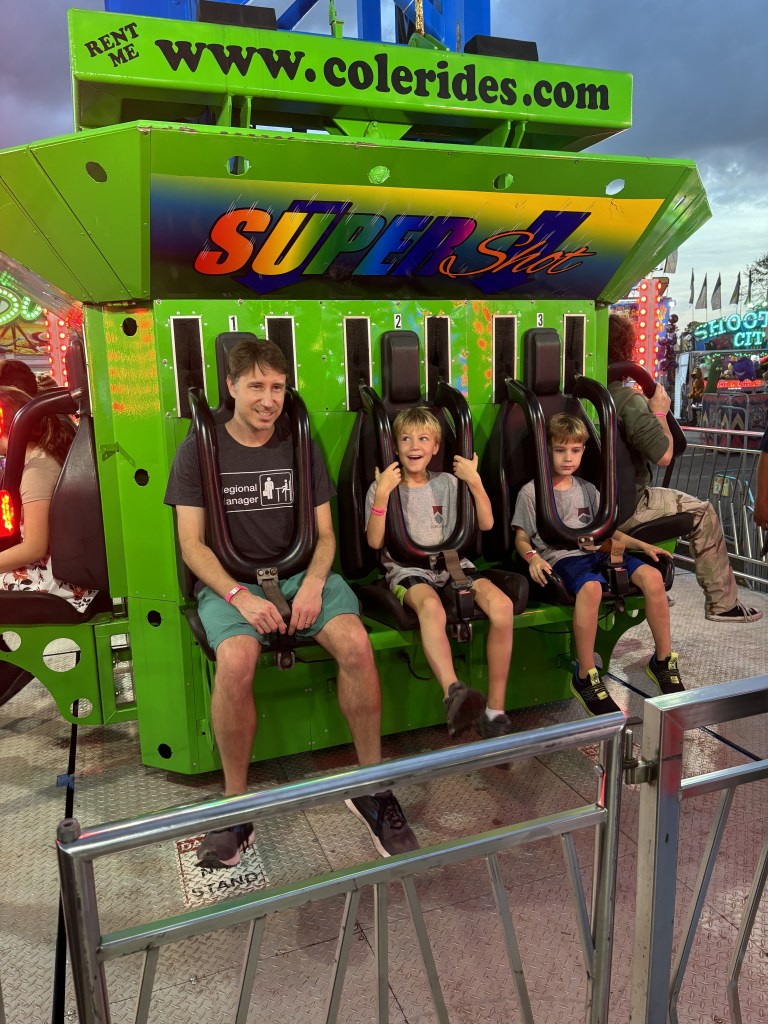
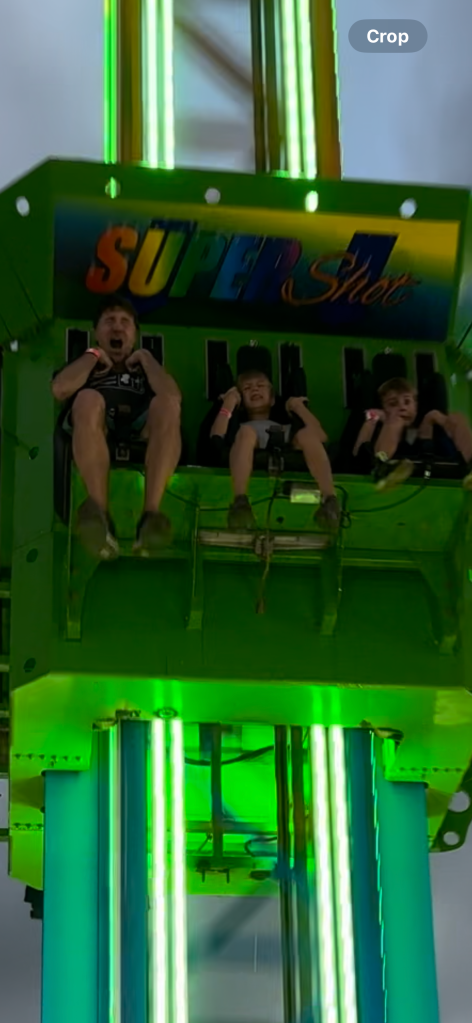
The “Supershot” is simply a tall tower with a cable system that lifts a gondola to its peak before dropping it back down to earth. By the time the boys and I buckled into the three seats on one of its four sides, it was near dark, the crowd was streaming in through the gates, and the fairgrounds were alive with the glow of blinking lights. The adrenaline started to flow in earnest about halfway up, at which point a sound like a jet engine revving up began to accompany the gondola’s ascent. Cartter, who rode in the seat between his brother and me, had counted the seconds it took for the previous group to reach the top, but we abandoned that plan to thwart the ride’s unpredictability when the kid behind us in line offered, “You want me to signal you when it’s gonna drop?” We agreed, only to realize once the jet engine started sounding that we could not see our new friend standing almost directly beneath our lofty vantage point. Scotty again made me think he might leap to his death rather than endure the frightening prospect of our carriage’s suspenseful climb. “Don’t look down,” I told him as he leaned forward, presumably searching for our signal man in the crowd below. “Look that way. Look at all the lights.” Higher and higher we crept, knowing not how close we were to the top, only that every inch brought us closer; with each passing second, our longing to be down increased in direct proportion to our nervous dread of the imminent drop until finally the ride went, “Click,” and we free-fell from eight stories in the air. Danyelle recorded the entire thing on her phone. I screamed through the descent, Cartter pumped both fists in triumph at the bottom, and Scotty turned to face us and said, “Oh my God.” It took fully ten minutes for my blood pressure to restore.
After corndogs and a half hour standing in line, the three of us were back in the sky again, enjoying a second go-round on the Ferris wheel. We admired the trail of headlights stretching into the distance below us, as people from miles around headed for the parking lot, their hearts carried by a Templeton-like lust for the delight of wicked excess. Scotty pointed out a “golden M,” a solitary beacon of the insatiable American appetite glowing amid a sea of darkness that surrounded it. On our way out, we gave cash to some carnies, and I threw a ball through a hoop and won a Gizmo, a stuffed animal version of the adorable creature from Gremlins that metamorphizes into an evil monster if it eats after midnight, a fitting fair prize if ever there was one. Finally, we piled back into the minivan and started back home on the interstate. “I’m glad I faced my rides,” said Cartter from the backseat.
“Me too,” I said. “You guys really manned up a lot today. I’m proud of you.” The dashboard’s soft blue lights glowed comfortingly as I cruised along, and I felt as one should after a proper visit to the fair: deeply satisfied.
 The Raging Elitist