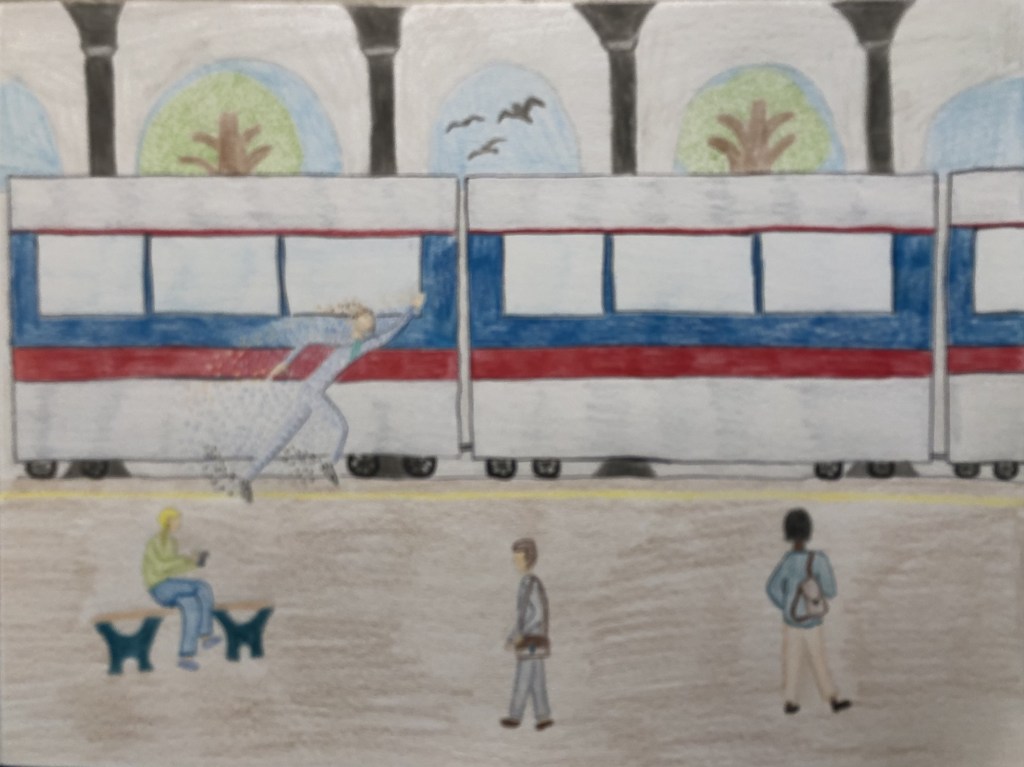
Behind schedule and running to catch a train in a crowded station, that intellectual giant Nassim Taleb, author of The Black Swan, suddenly stopped at his friend’s behest and took stock of his behavior. “I don’t run for trains,” his friend told him. I used to share that inclination.
I remember heading out from my friend’s apartment in my early twenties. We were walking towards the commercial district on King Street, past graveyards and churches and centuries-old homes with gardens behind brick walls and wrought iron gates, probably on our way to over imbibe at one of the bars we frequented, and I found myself rushed, my mind blocked up, distracted by my friend’s pace. Finally, I turned to him and said, “Why are you walking so fast? Slow down.” Even if he’d wanted to, he couldn’t have obliged me.
I slept perfectly in those days. I had a little apartment, a little job, friends, and few worries. Then things started speeding up. My friends moved away and got jobs in medicine, law, finance, and real estate. As time went by, I was increasingly preoccupied with how to explain myself to people, with how to answer that dreaded question, what do you do? I teach ESOL? I’m a swim coach? I’m independently wealthy? None of these are answers that people are looking for, and the kinds of people who now surround me, middle aged suburban strivers with kids, will often use them to justify their prejudice that you aren’t as deserving as they are, that you don’t belong, and then they’ll treat you accordingly. These social rebuffs bother me, because somewhere along the way, I became the kind of person who takes brisk walks for exercise and struggles to sleep at night. I became the kind of person who runs for trains.
Now, I’m working on unlearning this behavior. I read Daniel Kahneman and Taleb; I don’t serve on neighborhood boards; and I try to define my productivity for myself instead of deferring to people who (1) treat others according to their place in the societal pecking order and (2) don’t know me. This last bit is probably going to take a while to master. I don’t enjoy not meeting people’s expectations. The thought of it makes me want to withdraw into the study and avoid people altogether, which might not be any better than running for trains. In fact, it might be the same thing, just in the opposite direction.
Luckily, shunning the social ladder frees up a lot of bandwidth, and I can afford my boys a lot more attention than I’d otherwise be able to. At 5 and 7, they haven’t learned to run for trains yet, and observing them is instructive as to how I can unlearn some of my bad habits. When I start getting bored at the boat landing with Scotty, suggesting that we go see what his brother’s up to, he pauses his hunt for fiddler crabs at the edge of the marsh and tells me, “Let’s go down to the dock first.” Then he grabs a handful of rocks and carries them up the ramp so that he can drop them over the rail and watch them plop into the pluff mud below. When I get frustrated with Cartter for losing his jacket and start berating him on the way to school, he sits there in his booster seat, not having expected his day to start like this but taking it all the same, just waiting on this unpleasant bit to end. Looking over my shoulder while stopped at an intersection, the sight of him halts my temporary insanity, and when I apologize a moment later for yelling at him, he says simply, “It’s ok,” and we carry on as if it were nothing, because really, it was.
The kids are not fast walkers, and they find humor in nearly everything. When they accompany my wife and I for a late afternoon stroll, they either lag behind, ambling lazily along absorbed in some private conversation, or they sprint ahead laughing, purging their excess energy with a childish game, totally undisturbed by grating social pressures and obsessive anxieties, free. Hopefully, I can help them stay that way as much as possible rather than contribute too much to the heap of false expectations they’ll feel pressured to match. The more we try to put ourselves into a box for people, to force ourselves to make sense according to others’ notions of the way things should be but aren’t, the more we mortgage our humanity, a risky proposition in a world with so much uncertainty.
We’re so busy putting things in boxes that we often miss the uncertainty swirling around us, but in time the unknown will always trump our plans. I knew a girl in college who laughed almost as easily as my boys do. We got to know each other over a summer in Mexico and took buses and walked to and from class together not wanting to ever get where we were going. We fell out of touch after school, but I always assumed I’d run into her again at some point, until recently, when I learned that she died in a car crash. The world doesn’t care about our phony schedules.
At the end of his book, Taleb compares the odds of a person being alive to a tiny speck of dust floating next to a giant planet a billion times the size of Earth. The planet represents the odds against. Our coming and going makes so little sense. Running for trains while we’re here makes even less.
 The Raging Elitist