It’s easy to miss the entrance to the vet’s parking lot even when it’s not dark outside. Somebody is riding my bumper, and there’s a stream of headlights coming at me from the opposite direction as I look for the lefthand turn off Chuck Dawley Blvd. Normally, Sammy would be whining and panting in the front passenger seat next to me, but now she’s yawning and smacking. I make a mental note to add that to the list of symptoms in my notepad – lethargy, hiding, refusing to come, ducking her head, backing away from us. I’ve done this enough to know it’s best to be prepared.
Sammy has required frequent visits to the vet her entire life, starting when she was a wee pup. When we first got her, we thought she was a really “chill” dog, until her diarrhea prompted a vet visit and we found out she was actually just sick, like really sick. The vet was appalled she’d been sold to us in this condition. Apparently, we’d bought the puppy equivalent of a used car with sawdust in the transmission.
Sammy got to know her Delray vet well, even though she only lived down there a few months. The Delray vet called her “Sammy Wammy” and charged us discounted rates. She also prescribed Sammy multiple rounds of antibiotics and other drugs, and one time she sent us home with sanitary wipes and instructions to clean Sammy’s vagina for her twice a day. Apparently, Sammy’s constant licking was not getting the job done. Her puppy tongue was too small for her big dog vagina.
After treating Sammy’s myriad puppy illnesses, around the time we were cleaning her dog vagina twice daily, we discovered that she was not, in fact, “chill,” but rather very exuberant, so much so that she was uncageable. Literally. We couldn’t crate her. At first it was just because she would cry and howl so persistently that we would give up. Then, it was because she would bust out. It took us months to figure out how she was doing it. We were in a short-term rental in West Ashley, Danyelle’s belly swelling with pregnancy while we searched for a permanent home, when we finally caught her in the act. It was a really simple maneuver she deployed. She just rammed into the cage until the latch jostled loose. I’m pretty sure she didn’t understand the mechanism at work. She just knew that sometimes after launching herself into the cage door, it would magically open, and she would be free to go into the kitchen and devour anything sitting on the counter.
Uncaged adolescent Sammy’s eating rampages were the cause of most of our unplanned vet visits in those days. Her suicidal appetite rendered off-leash activity dangerous and mired resulting vet consultations in uncertainty – “We don’t know what she ate, doc. We just know that she’s more violently ill than usual this time.” When we moved to Mount Pleasant, the vet we started seeing pushed x-rays and bloodwork a lot, and she was reluctant to weigh in on whether we were looking at a life-or-death situation. When pushed, though, she erred on the side of death.
We are not going to see the vet of Sammy’s adolescence now. We have a new vet, one who’s helped us through Sammy’s more adult problems – a blown out knee, shoulder arthritis, and, most recently, a sprained elbow and the onset of osteoporosis. We started seeing him when he was working at the old Mount Pleasant vet’s office part time. Now, he has his own practice.
After I miss the entrance to the new vet’s parking lot and turn the van around, Sammy starts twirling in circles in the passenger seat and whining excitedly at the realization of what’s happening. Fear of probing has spurred her to life. Walking into the reception area, she’s transformed into the exuberant dog who cannot be caged. I have to drop the leash so that she can barrel into the exam room without injuring me. She’s desperate to crawl into her hiding spot under the two chairs against the wall, where she will cower and whimper as I read the notes that I’m so proud of to the tech hammering away at the keys on her laptop.
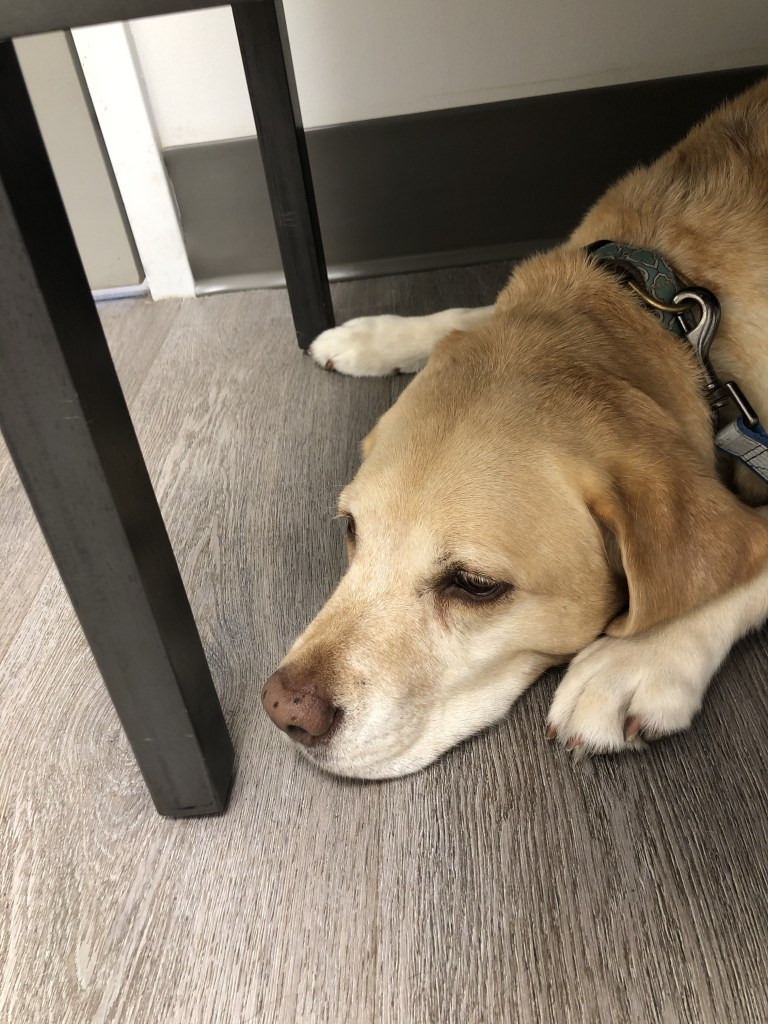
I know where this is headed – the same place all the poisoning visits end up – a conversation with the vet that revolves around whether I want to submit Sammy to additional testing that will effectively add a zero to the final tab. The words “obstruction,” “risk,” and “uncertainty” will get bandied about, and what I ultimately decide will depend on the answer to the question – “Is she going to die?” One of the key differences between the old Mount Pleasant vet and the new one is that the former’s answer to that question was always “Maybe,” and the latter’s is generally “Probably not.”
If I’m going to have the risk-of-dog-death conversation, I’m glad it’s in Dr. Epp’s office. Besides being less of an alarmist, the guy is flat out incapable of being wrong about my dog. If I were as right about anything as he is about Sammy, I would be an insufferable dick about it. He pulls it off with ease, though.
One of the first times I met him was shortly after the birth of our first child. My mother-in-law was staying at our house, attempting to outdo our newborn at throwing crying tantrums. Danyelle and I were new parents. Sammy was a year old. We had a lot on our plate. I’m sure Dr. Epp could see how drained I was, as I explained that Sammy’s eyes appeared to be rolling back in her head and that this pink membrane called a “third eyelid” was visible all the time. Basically, she looked like she was always on the verge of passing out. He laughed at me in a way that didn’t just make me feel stupid. It made me feel relieved too.
“She’s a high anxiety dog,” he said. “She’s freaking out because of the new baby, and she’s exhausted.”
“No, I’m freaking out because of the new baby, and I’m exhausted. I’m not here to talk about my problems. It’s the dog I’m worried about. Don’t you want to hook her up to some machines or something?” That’s what I might have said if I hadn’t been so surprised.
I was amazed on a few different levels. One, this guy was so confident in his assessment, and it had nothing to do with x-rays or bloodwork. Two, he was talking about my dog as if she were in possession of a psyche that could malfunction just like a person’s. Three, he made total sense. I couldn’t see the forest for the trees. This guy took one look at Sammy and me, and he knew exactly what was going on. Finally, he was talking to me as if the two of us were equals. People doctors could learn a lot from Dr. Epp.

Sitting in the waiting room with my notepad while Sammy gets probed in the secret employees only section, feeling responsible as I overhear the tech relaying all I’ve told her to the vet, I’m confident Dr. Epp would not mislead me. There’s just one problem. It’s 7 p.m. on a Friday. Dr. Epp is out, and I’m about to have a consultation with his after-hours underling.
The underling is solidly younger than I am and about two heads shorter. She’s immediately very convincing as a friendly, dog-loving veterinarian. We go over Sammy’s presentation and her recent history, which includes 17 days of exercise restriction following the sprained elbow she incurred on Halloween night. For 12 of those days, she was on the sedative gabapentin. The after-hours vet maintains a reassuring smile and an upbeat tone while we talk. Of course, we talk about the potential tests, but her level of concern seems low.
I think I’m doing a good job of speaking this vet’s language, asking the right questions, giving the right information, keeping it clinical. I’m probably one of the easiest people she ever has to deal with in this office – intelligent, organized, an efficient communicator, a really good dog owner. Then she mentions that the only thing she noticed during Sammy’s exam was that she may be experiencing some neck pain. Did she get tugged really hard, maybe? The once reassuring smile suddenly seems impenetrable. Wait, does she think I hurt my dog? I point to Sammy in her hiding spot and indicate her smacking, which makes me think she’s nauseous. The vet has a different idea. The lights in the room grow brighter as we lock eyes, and I feel my pupils dilate right at the moment she says the word “anxiety.” I’m transported back to that early visit with Dr. Epp. No, doc, she’s a dog. We can’t transmit our mental problems to her.
On the drive home, I call Danyelle, and she latches onto the idea that we’ve mistaken a mentally ill dog for a poisoned dog. “I think she’s depressed, because we haven’t been letting her do anything,” she says. In other words, we’ve effectively caged the dog who cannot be caged, and it’s broken her brain. We agree to start ramping up her exercise program more quickly.
At 8:30 the next morning, we’re at the boat landing with Sammy. Her ears are pricked up. She races to the water’s edge, freezes into a statue, and stares at the ball Danyelle is preparing to launch into the creek. For an instant Danyelle and Sammy are on either end of an ultra-taut, invisible line. Then Danyelle throws the ball, and Sammy wallops into the water in pursuit. She’s herself again. Oh my God, the uncageable really was depressed and anxious.
Sammy snorts loudly as she paddles against the current with the ball in her mouth, and I get frustrated with her as she pounces around in the shallows, insisting on toying with the ball she’s retrieved rather than let anyone else have it. She mouths it like a cat playing with a half-dead mouse and keeps it a safe distance from the water’s edge, my willful girl who’d rather repeatedly smash her cranium than allow you to put her in timeout in a crate. Already, I’m forgetting what has taken me eight years to learn – that beneath that thick skull, inside her little dog brain, Sammy’s psyche is fragile.
I’ve seen Sammy eat pounds of dead fish, lap up salt water, and recover almost immediately after she spews diarrhea all over the beach. I’ve seen her defy physics and jump over our back fence to go on a food-about. I’ve struggled to prevent her doing parkour on our furniture when she’s supposed to be recovering from injury. All the while I assumed her obstinate joy was a sign of emotional indestructibility. Turns out it was the opposite.
The dog who can’t be caged is an illusion, one I unwittingly allow my mind to perpetuate. We could have just put a padlock on her crate all those years ago, and Sammy would have never gotten out. I’m pretty sure we did at some point. I don’t like to think about it, though, just like I don’t like to think about Sammy suffering from psychological distress after all that gabapentin and exercise restriction. I prefer the illusion of her indestructibility. Standing at the water’s edge with a tennis ball in my hand, I want to reconstruct the illusion as quickly as possible, to see Sammy swim back and forth until the sads are knocked out of her brain for good. Of course, she isn’t cooperating. She’s a baby excited to play with her ball, a beast driven by instinct, an animal with its own life to live. She doesn’t want to be in a cage, not even one that’s just in my head.
 The Raging Elitist