
Dear Elite,
If I didn’t know that school administrators and healthcare professionals were actual heroes, I might find them pretty fucking annoying. I might even let them know about it. I might say things like “I have a week to sign the reenrollment contract? It says I will agree with the administration under penalty of expulsion and forfeiture of tuition? It’s January, motherfucker,” or “You’re raising the tuition 13% just because you can? Fuck you,” or “You thought I had Meniere’s disease, but now you think it’s vestibular migraines, and it means I can’t eat bananas? Peanut butter? Vinegar? There’s a whole long list of everything I eat here on this sheet of paper, you fucking bitch. Knock off the infantilizing tone and faux sympathy, ok? You’re just a PA, and you have no idea what you’re talking about. You’re just making shit up.” No, you don’t talk to heroes of Science like that. Instead you say things like “Let me just get my checkbook real quick, Mr. Headmaster” or “ok, I’ll stick to the diet, take the appointment with the specialist, and yeah, I’ll get the brain MRI to make sure there’s not something worse going on here.” In other words you submit – you relinquish control, and you hope for the best. Really, what other option is there? I mean, we’re not sending our elite halflings to (gasp) public school with the common riff raff, and in a weird way truly submitting to the condescending medical professionals is in itself a way of seizing control. It’s a willingness to sacrifice your money, your dignity, and, in the case of the migraine diet, everything that you enjoy eating and drinking – do you like pizza or chocolate? Do you drink alcohol? Caffeine? Not anymore, bitch – that’s you talking to yourself, and making yourself your bitch in case you were confused. In other words your submission is a form of elite self control; moreover, by giving yourself up to the scientific instruments, you might just discover the thing you’ve been waiting for all your life: the answer, the cold, hard realization that the feeling you’ve always had – that something about you was different, that one day it would all be revealed and you would cross over into enlightenment – that feeling was right! It’s happening right now! Your scan results show lesions that indicate you have Parkinson’s disease! Or better yet, you have stage 4 cancer! You’re going to die! Not instructions to cut out onions and beer as an intermediate step to uncover some sort of bizarre food sensitivity, not a referral to a PT to help “manage” chronic pain, a real fucking answer! An answer that validates your suffering! You really were special this whole time. Holy Randomness saved one of its rarest and most horrific ailments especially for you. You can stop worrying about your privilege now. Your life objectively sucks. Only Science can bring us such an epiphany, and so we elites yield to Science and its practitioners, and when I say yield, I mean lie down and literally take it in the ass if we have to.
My most recent yielding didn’t require any sort of anal probing, just 45 minutes inside an MRI machine. As the lady tech with the Midwestern accent loaded me up, wedging my head snugly into position, placing a sort of cage over my face, and sliding me into the little white tunnel, I asked her “What’s this thing in my hand?” It was like a black, palm-sized bladder with a hose attached to it. “That’s your panic button,” she said, “in case you change your mind.” Change my mind? Fat chance of that, I thought. A moment of weakness like that would just mean that however much time I had spent in this tiny, ruthlessly cacophonous tomb would have all been a waste, that I would have to do it over again, or worse, if I indeed lacked the courage to fully submit to the machine, I wouldn’t get the answer that Science had promised. I would have to go on not knowing, always wondering if my diligent adherence to the medical professionals’ instructions was for naught. No, changing my mind was not an option, and yet, staring at the grey stripe on the tunnel ceiling a foot and a half from my face, vertigo threatening to break through from behind my eyeballs, a sense of panic started welling up inside. I started to feel like I might freak out, like if I didn’t squeeze that ball and cry for help, I might just have a heart attack. Could it be that in my moment of truth, I would succumb to weakness and forfeit my right to know?
The truth is that my eliteness has plagued me all my life. I have indeed always felt that there is something that sets me apart, something that would probably reveal itself once I was a real adult, something that would relieve me of the tension that exists between the outside world and myself. When I was a child, I thought it was an Olympic gold medal in swimming; as an adolescent and young adult, there was the thought that I would accomplish something brilliant – a best-selling book, an important career, a magnificently successful investment – something that would end any need to prove the merit of my existence, but as I get further into middle age, the fear that what I’ve been waiting on is actually much more horrible has largely crowded out such delusions. Marie-Louise Von Franz describes it aptly: “Nowadays more and more people, especially those who live in large cities, suffer from a terrible emptiness and boredom, as if they are waiting for something that never arrives. Movies and television, spectator sports and political excitements may divert them for a while, but again and again, exhausted and disenchanted, they have to return to the wasteland of their own lives.”1 Right. See, I get what she’s talking about, and it’s very applicable theoretically. I mean, that is the feeling I’m describing, but there are some exceptions. For one, no way my life’s a wasteland. I’m elite! Something really is coming, and every day that it’s not something awesome, it seems more and more likely that it must be something terrible. Plus, we have phones to divert ourselves now. TV’s are really much more about getting the kids to shut up for a minute so that we don’t go insane, or vegging out when we’re sick, which it just so happens has been the case recently. Ok fine, Marie-Louise, you caught me at a bit of a low, so we’ll play along.
Von Franz recommends seeking a balance between a rich inner world of adventure and the ego’s outer world as the way out of the wasteland and into a meaningful life. The bad news is she makes it out to be kind of difficult. “Trying to give the living reality of the Self a constant amount of daily attention is like trying to live simultaneously on two levels or in two different worlds,” she says. “One gives one’s mind, as before, to outer duties, but at the same time one remains alert for hints and signs, both in dreams and in external events, that the Self uses to symbolize its intentions – the direction in which the life-stream is moving.”1 Alright, that would be hard even without Covid in the house. Here’s Kierkegaard 200 years prior on the notion of achieving the experience of this world (finitude) and the spirit world simultaneously and continuously: “But by my own strength I cannot get the least little thing of what belongs to finitude; for I am continually using my energy to renounce everything.”2 Gosh, how bout some cheese to go with that whine? Despite Kierkegaard being a Christian and therefore a subelite, we will concede that he was in possession of considerable mental powers, and for him, turning his attention inward was so exhausting that he became unable to live a normal life in the outside world, yet here’s Von Franz, telling us to just do both at the same time. Perhaps if Kierkegaard had been a 21st century parent waiting on Science’s version of judgment day, his body racked by Covid, he’d have said to Marie-Louise, “Look, bitch, I can’t even hear myself think in this fucking house right now. I’m turning on the TV. Quit judging me.” Yes, leave the judgment to the scientific instruments . . . and the kids.
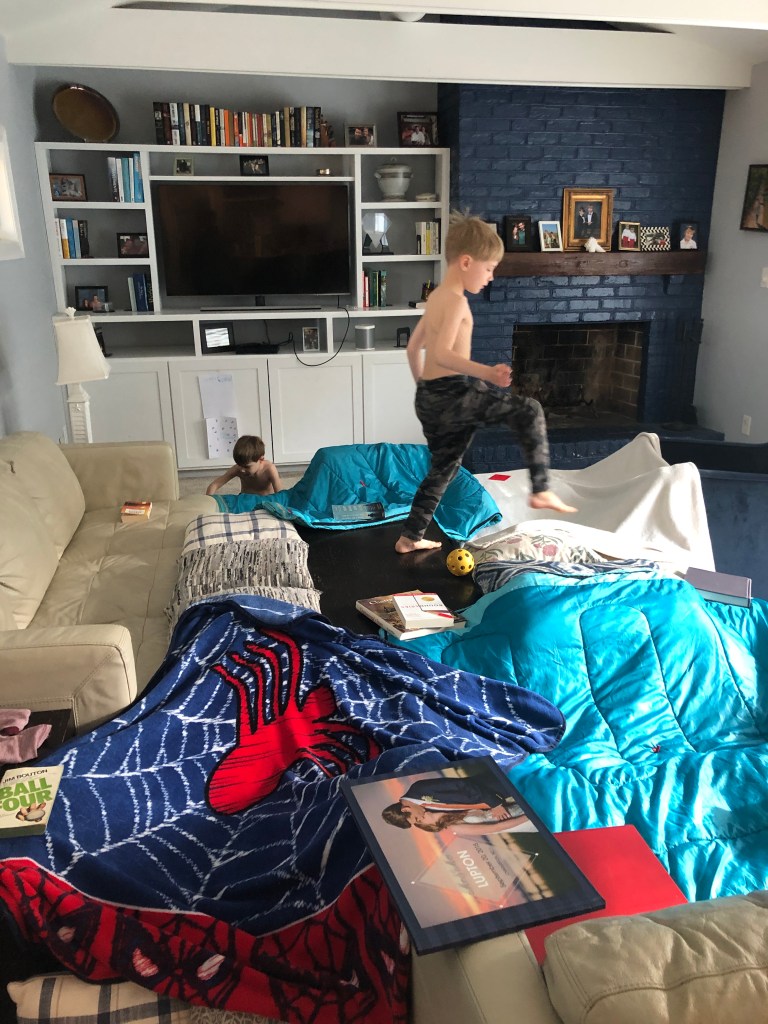
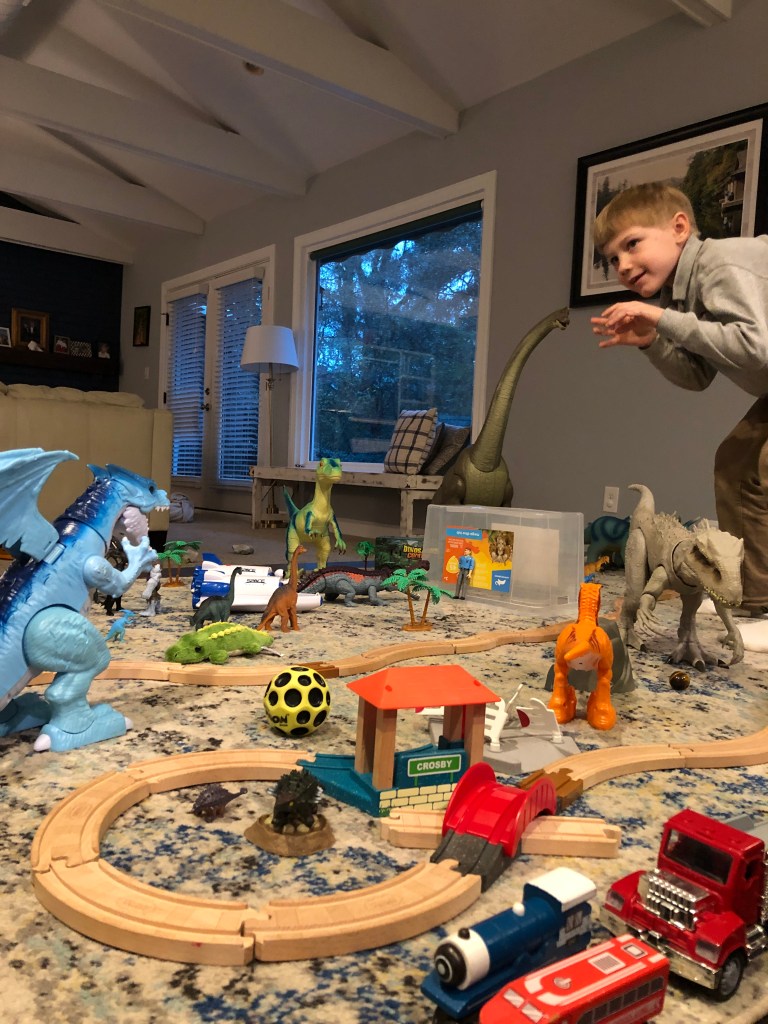
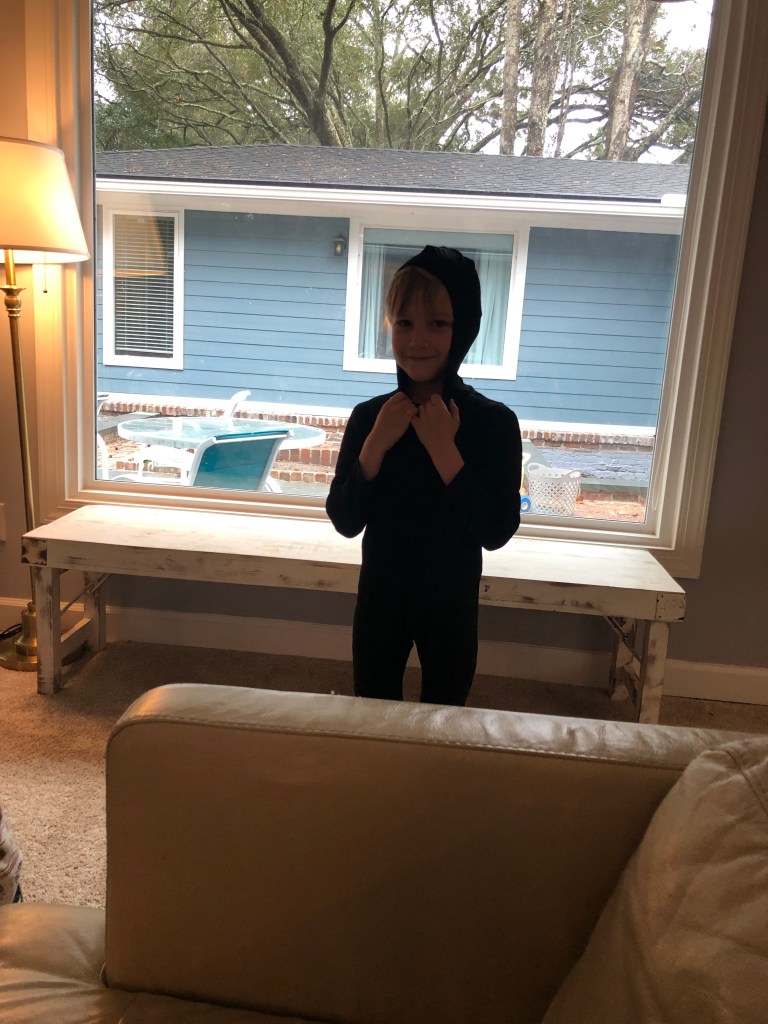
Now, I will allow the possibility that I may at times tend excessively toward introversion, that I occasionally lapse into a view of the outer world as a distraction amid my quest for the Great Man’s voice. The consequence? The distraction of the outer world grows louder, shriller, more annoying. I’m talking mostly about the shrieks and disturbing behavior of my children. It would seem that like Von Franz, they demand a perfect balance between my inner and outer worlds, and like Kierkegaard’s God, there is no escaping their judgment. It goes like this: Mommy and Daddy are overly distracted? Time to be bad. That didn’t work? Be worse. Much of their dissatisfaction with our parental ADD manifests in the form of screaming fights that end with tears and cries for help or claw-marked faces like something from an X-Men comic. Certainly, there will be toys strewn about the entire house, “floornaments” if you will. Obviously, that shit is the worst. Occasionally, though, there’s the lucky coincidence that their bad behavior is hilarious, and instead of presenting a distraction from the business of “renouncing everything” (or from taking refuge from the wasteland inside a screen) it’s more like a call from the outer world that resonates within. It’s Cartter dressed up like a ninja, saying his mommy is going to make all the cake in the world and then to me: “you’re gonna eat it and get big and fat, and we can use you as a punching bag. We might even jump in the air and kick you.” Or maybe it’s his little John Wayne voice emanating from the kids’ bathroom where he’s gleefully practicing cussing with his brother: “Git yer dumb ass outta here!” Cussing is in, by the way. While Mommy and Daddy have been laid up and slacking, we’ve seized the moment to practice using all the forbidden words around the house, and I mean all of them. Strangely, these moments of apparent discord can be like when you suddenly look up from your table in the bar and ask “hey, what is this song?” Of course, by the time anyone gets Shazam to open on their phone, it’s too late, and you’re left with the empty truth that you’ll never know, at which point the impending doom of the scientific instruments’ verdict rumbles deep beneath the surface and sends up vague feelings of unease.
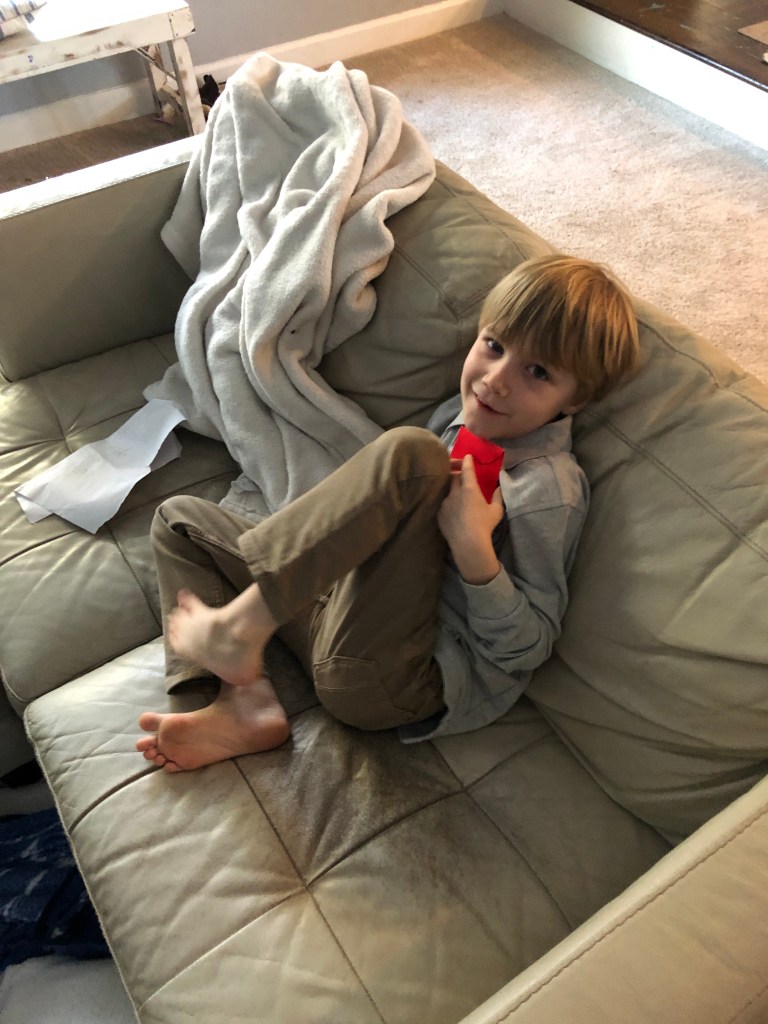
Of course, the holy practitioners called when we were out to dinner on Friday evening, our first family restaurant outing in quite a long while, and of course, I missed the call, feeling the notification in my pocket whilst waiting for the waitress to return and take our order. “Order for me,” I told Danyelle. I walked outside to the most discreet corner of the front patio at “Public House,” my phone pressed against my ear blaring hold music, Danyelle texting me overly specific questions about what to order on my burger, my kids playing Uno back at the table, and a premonition swept over me. It was like the dissolution of the panic that had welled up during those first few moments inside the tunnel: this wasn’t the awful moment of truth that my life had been building towards. I wasn’t about to be freed from the wasteland. After explaining myself to a receptionist and holding some more, I was greeted by the voice of a male “medical assistant,” (a medical assistant to the physician’s assistant), friendly if a bit whimsical and dismissive. The voice let me know that the scan of my brain revealed no abnormalities, going into some detail about the different regions inside my skull, and thanking me for my patience. I would later read the radiologist’s report myself. The final word: “an unremarkable scan of the brain.” What?! Unremarkable?! Perhaps the scientific instruments are not as all-seeing as we thought. Worse than the radiologist’s flippant attitude towards the image of an elite brain, though, was the medical assistant’s parting shot: “We can carry on with the current treatment plan.” Oh, sure bitch, whatever you say, but right now I’m going to sit down with my family and eat a cheeseburger, with onions!
Back at the table, Danyelle was eager to know what I’d learned. I told her they found nothing. She was relieved. The kids, on the other hand, were perfectly clueless, their voices rising far above the rest of the noise in the dining room, loudly disputing the fairness or unfairness of some aspect of the current Uno hand. Scotty, in particular, was shouting. During the sick period, Scotty has been shouting a lot. Mommy and Daddy semi-incapacitated by Covid, worrying about their own personal health, failing to pay him the proper attention doesn’t really jibe with his insistence that while he may be nearly 5, he still wants to be a baby. As I’ve said before, his brother’s complete abandonment of babydom only deepens his 4-year-old existential crisis. It causes him to let out desperate screams of “Cartter! Stop it!” that echo all through the neighborhood as his brother speeds away from him on his scooter. His brother’s growth is evidence that his own babydom is approaching its death, and his terror manifests in pleas of “I don’t want to pick it up! I want someone to help!” as a basketball rolls to a stop inches from his feet. His infantile neurosis surfaces in pitiful grunts as he tugs at his seatbelt and proclaims, “I can’t!” when faced with the promise of “no cookie” upon arriving home. Weakened, his mother and I have lately resorted more than normal to outbursts along the lines of “I said stop it!” (Danyelle) or “I don’t like the way you’re acting!” (me, roughly grabbing his arm and then sending him to his room). Of course, this is music to Cartter’s ears, and he does his part too: “Scotty, everybody knows it’s all your fault.” With nobody obeying his commands, deprived of his cookie, facing the death of his babyhood, Scotty is making his initial foray into the wasteland. If he can’t have the attention he desires, give him distraction, he says. For him watching a movie is the greatest possible thing that a person could ever do. What is less than great is being forced to have family reading time before bed. That means no potty humor books or Dr. Seuss. These days it means the little kid intro to philosophy book that both Granny and G got us for Christmas. Woe is Scotty! This book is hardly a distraction at all! So, after we drove home from the brain scan reveal dinner, after I flushed the turd that Cartter had left marinating in the hallway bathroom, I was serenaded by pitiable grunts and squirms on the couch next to me as I read a chapter entitled “The Meaning of Life.” Distracted as I may have been by the overgrown baby wrestling with itself in the seat next to me, I was drawn in by the kiddie book’s message. The basic concept was that life presents problems, and we derive meaning by fixing them. Suddenly, the whimpering beside me and the inner voice struck a perfect harmony. Hey, what is this song? Quicker than you could open Shazam, I was peering at my youngest son and emphasizing that “When you fix something, you solve a problem that matters to you.”3 The boy quit his bitching and looked at me, a mischievous gleam in his eye, delighting in my attention, in the knowledge that he was my problem. Cartter, ever the A student, chimed in with the apparent right answer: “Scotty’s the problem!” And just like that I was back up on the tight rope between the inner and outer worlds, suspended above the wasteland, an unremarkable brain with elite self control, in no need of distraction.




The Elite-ist Sitcom
Infinite thanks to Larry David, whose season 11 of Curb was the exact distraction required for the first day and a half of Covid. If ever someone understood what it means to be truly elite, it’s LD. During our binge we discovered one episode that bears a striking resemblance to the biblical story of Bartimeo, which we will now share. First, the Bible story. Bartimeo is the blind beggar, who sits at the gates to Jericho, and when he hears that Jesus is approaching, he loses his shit and starts shouting for Jesus to restore his sight. The surrounding crowd rebukes him, but he persists, and Jesus calls for him. Here’s his response from Mark 10:50: “Throwing his cloak aside, he jumped to his feet and came to Jesus.” The blind man’s cloak is his most valuable possession, and he casts it aside to be restored by Jesus. Here’s a relevant tidbit from Hebrews 12:1-2: “let us throw off everything that hinders and the sin that so easily entangles. And let us run with perseverance the race marked out for us, fixing our eyes on Jesus, the pioneer and perfecter of faith.” Bartimeo isn’t going to trip over his robe on the way to his savior. He’s fully willing to throw away everything forever in pursuit of the one true glory. Larry’s story is the perfect inverse. In one of the later episodes, Larry happens across a bicyclist lying injured on the curb. He calls EMS, and covers the man in the sweater off his back so that he won’t be cold. When the paramedics show up, Larry is very loud about his involvement, prompting the responder’s ire: “Why are you yelling? Do you want to be a paramedic? Go away, and let me do my job.” I’m paraphrasing, but that’s basically it. Larry informs him that “I’m the one who called! That’s my sweater!” Finally, when the ambulance rolls away, and Larry realizes that his garment is still on the cyclist, he waves his arms in despair, shouting to the heavens, “My sweater!” So while Bartimeo is rebuked for crying out for help, Larry is rebuked for crying out that he’s helping, and while Bartimeo casts aside his most precious robe in an act of supreme faith, Larry laments the loss of a sweater that hangs beside many others in his wardrobe. He, of course, goes to great lengths to recover it to no avail throughout the rest of the episode. This is but one of many priceless insights into the absurdity of elite life that LD provides throughout the course of the season. Larry, if you’re reading, fucking thank you. Thank you so much.
The Brads are . . . elite?
After watching Clemson basketball score 49 in the 2nd half to win on the road by 1 point in Tallahassee and move to 10-1 in the ACC, good for first place by a game and a half, we have to ask, is this team elite? They sure look like it: depth, size, athleticism, shooting, and out of nowhere just amazing coaching. Maybe those two assistant hires in the offseason really were what Brad needed. Seeing Chase Hunter go the length of the floor for the and-one to go ahead with 4.5 seconds left was one of the finest moments we elites have ever witnessed in Clemson basketball. Let’s beat the fucking Eagles in Chestnut Hill tonight.
References
- Von Franz, Marie-Louise. Man and His Symbols. Dell Publishing, 1968. Pg 227-228.
- Kierkegaard, Soren. Fear and Trembling. Penguin, 2003. Pg. 78.
- Big Ideas for Curious Minds, An Introduction to Philosophy. The School of Life, 2018. Pg 112
 The Raging Elitist